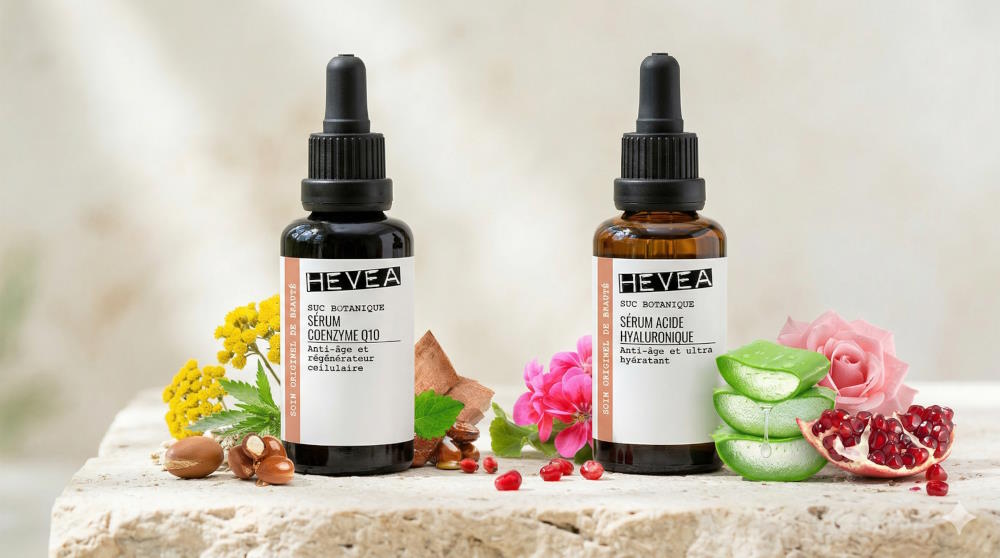
Facial serums guide: benefits of hyaluronic acid and coenzyme Q10
Skin care has evolved from a simple hygiene routine into a true discipline based on cellular biology and cosmetic chemistry. At the heart of this dermatological revolution are serums, formulations that have transformed the way we understand skin hydration, protection and regeneration.
Unlike traditional moisturisers, which act mainly on the surface to prevent water loss, serums are high-precision vehicles designed to deliver high concentrations of active ingredients directly where the skin needs them most.
Skin and serum. A union for care
To understand the impact of these products, it is essential to look at the anatomy of the skin. The skin barrier, specifically the stratum corneum, is evolutionarily designed to keep pathogens out and water in. Penetrating this barrier requires a masterful formulation.
Serums achieve this by eliminating heavy occlusive ingredients (like dense butters and waxes) and using smaller molecules that can bypass the superficial layers of the epidermis. This makes them an indispensable step in any facial care regimen aimed at real, long-lasting results.
Two of the most researched and dermatologically backed active ingredients are: Coenzyme Q10 and Hyaluronic Acid. Let's delve into their biology, their benefits, and how their topical application in serum form can drastically influence the health and appearance of the skin.
Coenzyme Q10: the energetic motor and cellular shield
Skin ageing is a complex process driven by two main factors: intrinsic ageing (chronological and genetic) and extrinsic (caused by environmental factors such as UV radiation, pollution and stress). Both processes converge on a common denominator at the cellular level: oxidative stress and decreased metabolic energy. This is where ubiquinone comes into play.

Coenzyme Q10, also known as ubiquinone, is a fat-soluble molecule found naturally in almost all cells of the human body, particularly in the mitochondria, which are the cellular "powerhouses"1. Its biological function is twofold and indispensable: on the one hand, it actively participates in the production of ATP (adenosine triphosphate), the energy currency cells use to carry out collagen synthesis, DNA repair and cell division. On the other hand, it is one of the body's most potent endogenous antioxidants.
Why use it
Over the years, and especially after the age of 30, natural levels of ubiquinone in the skin drop drastically. This decline leaves cells with less energy to repair themselves and more vulnerable to damage caused by free radicals, unstable molecules that destroy collagen and elastin fibres.
The topical application of this active ingredient compensates for this deficit2. By penetrating the epidermis, it works by neutralising free radicals before they can damage cellular structures. This visually translates into a significant reduction in the depth of fine lines, an improvement in skin firmness and a noticeable decrease in the signs of photoageing (sun-induced damage). Furthermore, by boosting cellular metabolism, the skin regains a brighter, more even tone, moving away from the dull appearance characteristic of skin fatigue.
When to start using it
Given that endogenous production begins to decline from the age of 25, this is the ideal time to introduce this active ingredient as a preventive measure. However, its use becomes highly recommended and almost mandatory from the age of 30 and 40, when accumulated oxidative damage begins to manifest in the form of expression lines and a loss of elasticity.
Nevertheless, it is never too late to start; mature skin benefits enormously from this extra boost of cellular energy.
Key ingredients in the formulation
A good cosmetic vehicle for this active ingredient usually incorporates synergistic ingredients that enhance its absorption and stability. Being a fat-soluble molecule, it is commonly found suspended in botanical oils with a high affinity for the skin.
Ingredients such as rosehip oil (rich in natural vitamin A) or jojoba oil (whose lipid profile mimics human sebum) are ideal companions. These oils not only facilitate the deep penetration of ubiquinone but also provide their own essential fatty acids (omegas 3, 6 and 9), reinforcing the intercellular cement and providing deep nourishment without clogging pores.
How to apply it
- Cleansing: On clean and preferably toned skin.
- Dosage: Just 3 or 4 drops are enough to cover the face, neck and décolletage.
- Massage: Apply using a gentle upward massage, allowing the lipid base to melt into the skin.
- Routine: It can be used both day and night. If used in the morning, its antioxidant power will act as a second line of defence under sunscreen, neutralising free radicals generated by UV radiation that manages to pass through the filter.
Hyaluronic acid: the ultimate hydration matrix
If ubiquinone is the cell's energy, glycosaminoglycans are the ocean in which these cells live. The most famous and vital of them all is, undoubtedly, the molecule responsible for maintaining tissue turgor and hydration.
Hyaluronic acid is a linear polysaccharide that is a structural part of the skin's extracellular matrix, the three-dimensional network that supports cells and collagen and elastin fibres3. Its most amazing biophysical characteristic is its hygroscopy: it has the ability to attract and retain up to a thousand times its own weight in water.

Why use it
Healthy skin is, by definition, skin rich in water. However, factors such as sudden temperature changes, heating, air conditioning, harsh soaps and the inevitable passage of time cause what is known in dermatology as Transepidermal Water Loss (TEWL). When the skin becomes dehydrated, the extracellular matrix slightly collapses. This causes the skin to look dull, feel rough to the touch and, most notably, fine dehydration lines appear that are often confused with premature wrinkles.
Applying this molecule topically acts as an immediate "glass of water" for the cells. It replenishes water deposits, producing an almost instant plumping effect. Fine lines are smoothed, the texture becomes elastic, and the skin regains a healthy glow. In addition, well-hydrated skin has a much stronger barrier function, making it less prone to irritation, inflammation and external sensitivity.
When to start using it
Unlike strictly anti-ageing or regenerating active ingredients, deep hydration is a universal need that knows no age. From adolescence, especially if drying treatments for acne are being used, to the most advanced maturity. It is the most transversal active ingredient in cosmetics. Its tolerance is high, since it is a biocompatible molecule (the human body already produces it), so the risk of allergic reactions or rejection is practically nil.
Key ingredients in the formulation
The efficacy of this active ingredient depends largely on its molecular weight. The most comprehensive formulas combine high molecular weight molecules (which stay on the surface creating a viscoelastic film that prevents water evaporation) with low molecular weight molecules (which penetrate deeper into the epidermis to replenish internal water reserves)4.
In addition to the main molecule, the most exquisite formulations often replace conventional water with floral waters or pure hydrolats. Rose hydrolat, for example, not only acts as an excellent aqueous vehicle, but also provides soothing properties, mild astringents, and a natural scent that turns the skincare routine into a comforting sensory experience. A valuable addition are also extracts rich in mucilage, such as aloe vera, which enhance the soothing and healing action.
How to apply it
Its use is similar to that of the coenzyme Q10 serum. The correct application of this active ingredient is crucial to its success; incorrect use can, paradoxically, dehydrate the skin.
- Prior moisture: As a humectant that attracts water, it should never be applied to completely dry skin. The face must be slightly damp after cleansing or after misting a facial spray or toner. If applied to dry skin in a low-humidity environment, the molecule might try to extract water from the deeper layers of the skin, achieving the opposite of the desired effect.
- Dosage: A few drops (2-3) are enough, as it has a high spreadability.
- Massage: Distribute with gentle touches (patting technique) all over the face, eye contour, neck and décolletage until fully absorbed.
- Sealing (vital step): Immediately after it is absorbed, it is strictly necessary to apply a moisturiser containing emollient or occlusive ingredients (such as ceramides or squalane). This creates a "seal" on the surface of the skin, trapping the molecule and the water it has attracted inside, preventing it from evaporating into the atmosphere.

The synergy of active ingredients in the daily routine
Formulating skin care products is a delicate balance between science and nature.
While one active ingredient provides the energy and antioxidant defence needed to combat cellular damage, the other provides the optimal aqueous environment for those cells to function properly.
Regarding skin health, it is vital to understand that there is no single "miracle" ingredient. The skin is a complex organ that requires a multifactorial approach. Building a routine is not about stacking products at random, but understanding the physiological needs of the epidermis.
Integrating light and concentrated textures, such as serums, allows you to customise your routine without overloading the skin. They can be used at different times of the day (for example, antioxidants in the morning to protect against environmental aggressors, and powerful regenerators/moisturisers at night to assist in the natural repair process during sleep), or even layered, always applying from the most aqueous texture to the most lipidic or dense.
-
Structural hydration and oxidative protection are the pillars on which healthy, resilient skin is built, capable of ageing while maintaining its functionality and natural radiance over the years.
Frequently Asked Questions (FAQ)
These are some of the most common questions we receive from users interested in our botanical serums and their application:
At what point in my facial care routine should I apply the serum?
The serum should always be applied to clean skin and, preferably, slightly damp with a floral toner. It goes between cleansing/toning and applying your moisturiser or night facial oil. It is the high-concentration vehicle, so it needs a clear path to penetrate.
Is the Coenzyme Q10 serum suitable for all skin types and ages?
Yes, Coenzyme Q10 is a transversal antioxidant that benefits all skin types, especially from the age of 25-30, when the body's natural Q10 production begins to decrease. It is an anti-ageing and regenerating treatment, making it ideal for combating signs of cellular fatigue, dull tone and loss of firmness.
How should I store the serums so they don't lose their properties?
Being formulated with pure botanical ingredients and active compounds sensitive to oxidation (such as Coenzyme Q10 and cold-pressed vegetable oils), it is essential to protect them from direct sunlight and sudden temperature changes. Thanks to its dark glass bottle (amber), the formula already has an excellent protective barrier, but we recommend always storing them in a cool, dry place, away from sources of heat or extreme humidity. This way, you will guarantee the maximum stability and efficacy of its active ingredients from the first to the last drop.
Bibliography
- Crane, F. L. (2001). "Biochemical functions of coenzyme Q10". Journal of the American College of Nutrition.
- Knott, A., et al. (2015). "Topical treatment with coenzyme Q10‐containing formulas improves skin's Q10 level and provides antioxidative effects". BioFactors.
- Papakonstantinou, E., Roth, M., & Karakiulakis, G. (2012). "Hyaluronic acid: A key molecule in skin aging". Dermato-endocrinology.
- Essendoubi, M., et al. (2016). "Human skin penetration of hyaluronic acid of different molecular weights as probed by Raman spectroscopy". Skin Research and Technology.
About the author
Content researched and written by the Anastore editorial team.
Reviewed and verified against scientific literature by our Nutrition and Research Department.
Find out more about our editorial policy and scientific rigour.

This article is strictly for informational purposes and does not replace the advice of a healthcare professional.