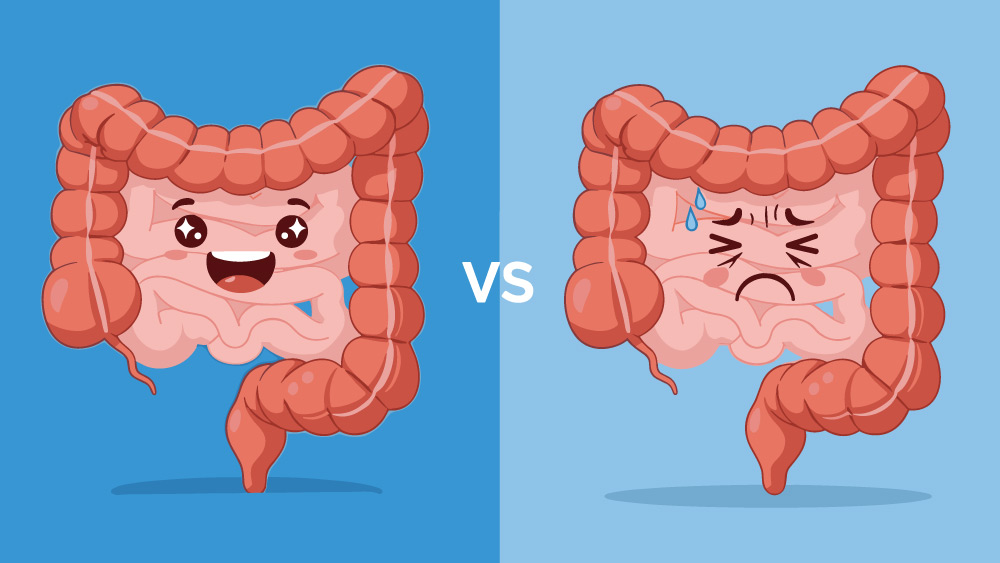
Why fibre is not enough for good intestinal transit
In the field of nutrition and food technology, for years digestive health has been simplified to a question of fibre quantity.
The message was simple
If you have transit problems, consume more bran or psyllium
However, that solution does not always work as we expect.
When we faced the idea of formulating a solution for intestinal wellbeing, Colon-D, the question was not which ingredient is good?, but rather how do these ingredients interact with each other and with the human epithelium? This is the basis of synergistic formulation.
We are going to analyse why we have considered that the combination of lactic bacteria, psyllium, grape and acerola is an effective formula for those cases in which fibre is not enough.
To begin with, here are the main characteristics of this synergy to promote digestion and intestinal transit:
| Ingredient | Physiological function | Main benefit in the synergy |
|---|---|---|
| Psyllium (Plantago ovata) | Soluble fibre with high mucilaginous capacity. | It acts as a mechanical regulator of transit and as a prebiotic, providing the necessary substrate for colon health and the production of short-chain fatty acids. |
| Lactic bacteria | Probiotic microorganisms (280 million CFU). | They repopulate the intestinal microbiota, balance the luminal pH and reinforce the defensive barrier against opportunistic microorganisms. |
| Acerola extract (vitamin C) | Natural antioxidant and enzymatic cofactor. | Contributes to normal collagen formation for the maintenance of the mucosa and protects intestinal cells against daily oxidative damage. |
| Grape seeds (95% OPC) | Polyphenols (oligomeric proanthocyanidins). | They offer advanced protection against local inflammation and help preserve the integrity of the "tight junctions" of the intestinal epithelium. |
The fibre paradox. What experience tells us
From our experience in the development of food supplements and the follow-up of cases in nutrition, we have frequently observed what we call the fibre paradox. A person arrives with chronic discomfort, heaviness and irregular transit who, upon general recommendation, decides to drastically increase their intake of insoluble fibre or isolated psyllium.
The result, in many cases, is a worsening of the symptoms: greater abdominal distension, gas and a feeling of "blockage". Why does this happen if fibre is "good"?
The answer lies in the previous state of the intestinal ecosystem. If the mucosa is inflamed (oxidative stress) and the microbiota is unbalanced (dysbiosis), introducing a large load of fibre is like sending a cleaning squad to a building whose foundations are crumbling and whose doors are blocked. The fibre arrives, does not find the right bacteria to be fermented correctly and ends up irritating an already sensitive epithelium.
Why we have formulated Colon-D
Here we came to the conclusion that "cleaning" is not enough; the ground must be prepared, the walls protected and the presence of the "maintenance staff" (the bacteria) ensured. For this reason, an advanced formulation for colon care must integrate several fronts of action.
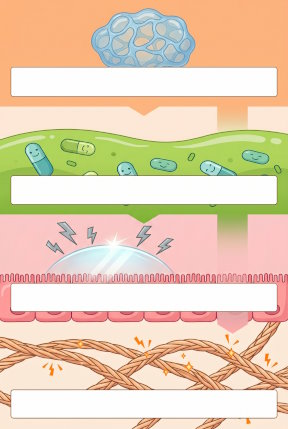 PsylliumForms a soft gel that regulates transit and nourishes the flora Lactic BacteriaRepopulate the colon and balance intestinal pH PolyphenolsCreate an antioxidant shield that protects cells Vitamin CReinforces collagen for a firm barrier
First pillar: psyllium as a structural matrix, not just a "broom"
Psyllium seed husk powder (Plantago ovata Forssk.) is a staple ingredient in digestive formulations for a physicochemical reason: its gelling capacity. Unlike cereal fibres which can be abrasive, psyllium creates a mucilage, a viscous network that retains water.
Psyllium: a biological sponge
Psyllium is capable of absorbing up to 20 times its weight in water. In the laboratory, we can see how a small spoonful of these seeds transforms a glass of water into a dense gel in a matter of minutes. This ability is what allows it to gently "sweep" the colon walls whilst hydrating the faecal bolus, perfect for transit without irritation.
From a formulation point of view, psyllium acts as the "vehicle". By forming this gel, it slows down the absorption of sugars and fats, but above all, it provides smooth transit that does not damage the enterocytes. However, its real value in a synergistic formula is to serve as a support for the microbiota. The slow fermentation of this mucilage in the colon produces short-chain fatty acids (SCFAs), essential for colonocyte health¹.
Second pillar: biological repopulation through lactic bacteria
Formulating fibre without probiotics is leaving the job half done. Lactic bacteria are responsible for metabolising these prebiotics. In a well-designed product, by including a significant load (280 million CFU per dose) we ensure that, after the mechanical cleaning of the fibre, colonies are established that acidify the environment, hindering the survival of pathogens.
The synergy here is clear: the fibre protects the bacteria during their transit and serves as food when they reach the colon. In turn, the bacteria transform the fibre into anti-inflammatory compounds. It is a virtuous circle of symbiosis that single-component supplementation cannot replicate².
Third pillar: grape for antioxidant protection and mucosa repair
This is the point where most commercial formulas fail. The colon is a place of high metabolic activity and, therefore, of high oxidative stress. Reactive oxygen species (free radicals) damage the "tight junctions" of the intestinal barrier.
To prevent this we have resorted to polyphenols. Grape seed dry extract (Vitis vinifera L.), standardised to 95% proanthocyanidins (OPC), acts as a reducing agent.
These compounds not only neutralise free radicals, but have been shown in cellular model studies to help maintain the integrity of the intestinal barrier, preventing toxins from passing into the bloodstream³.
Fourth pillar: vitamin C as a reinforcement for the intestinal barrier
-
Vitamin C contributes to the protection of cells against oxidative damage and to the normal function of the immune system5, two critical functions when we talk about a barrier that separates us from billions of bacteria.
The protection offered by the grape is reinforced by vitamin C, especially when it comes from natural sources such as acerola fruit dry extract (Malpighia glabra L.). Acerola not only provides ascorbic acid, but also cofactors that improve its stability. Vitamin C is essential for the synthesis of collagen, the structural protein that maintains tissue cohesion, including the delicate mucosa of the colon⁴.
Acerola vs synthetic vitamin C
At Anastore we value the matrix of the fruit. By using acerola instead of pure synthetic vitamin C, we are introducing bioflavonoids. These compounds act as "bodyguards" for vitamin C, preventing its premature oxidation before it reaches its function in the body. It is an example of how nature has already designed synergies that we simply try to replicate in advanced formulas.
The fundamentals of Colon-D
Formulating a digestive product is not about adding ingredients at random, but about understanding physiology. We need:
- Mechanics: psyllium for movement and mucilage formation.
- Biology: lactic bacteria for flora balance.
- Biochemistry: grape OPC and acerola vitamin C to protect tissue from oxidative damage and promote structural regeneration.
Only through this synergy can we move from a simple "cleanse" to a true restoration of the intestinal ecosystem.
Side effects and contraindications
Although the aforementioned ingredients have an excellent safety profile, their use is not without considerations. Increasing fibre intake (psyllium) can cause gas, bloating or changes in bowel rhythm during the first few days. It is essential to increase water intake; otherwise, psyllium could cause the opposite effect to that desired. Grape seed extract may have very mild blood-thinning effects at very high doses. Acerola, being a natural source of vitamin C, is very safe, but excessive doses of vitamin C could cause gastric discomfort or osmotic diarrhoea in particularly sensitive people.
It is important to always follow the labelling instructions.
Bibliography
1. The Effect of Psyllium Husk on Intestinal Microbiota in Constipated Patients and Healthy Controls. Jalanka, J., Major, G., Murray, K., Singh, G., Nowak, A., Kurtz, C., Silos-Santiago, I., Johnston, J. M., de Vos, W. M., & Spiller, R. (2019). International Journal of Molecular Sciences, 20(2), 433.
2. Effects of Probiotics, Prebiotics, and Synbiotics on Human Health. Nutrients, 9(9), 1021. Markowiak, P., & Śliżewska, K. (2017).
3. Proanthocyanidin-Rich Grape Seed Extract Reduces Inflammation and Oxidative Stress and Restores Tight Junction Barrier Function in Caco-2 Colon Cells. Nallathambi, R., Poulev, A., Zuk, J. B., & Raskin, I. (2020). Nutrients, 12(6), 1623.
4. Vitamin C and Immune Function. Carr, A. C., & Maggini, S. (2017). Nutrients, 9(11), 1211.
5. COMMISSION REGULATION (EU) No 432/2012 of 16 May 2012 establishing a list of permitted health claims made on foods, other than those referring to the reduction of disease risk and to children's development and health.
About the author
Content researched and written by the Anastore editorial team.
Reviewed and verified against scientific literature by our Nutrition and Research Department.
Find out more about our editorial policy and scientific rigour.

This article is strictly for informational purposes and does not replace the advice of a healthcare professional.