
How moringa helps reduce tiredness: benefits and nutritional analysis
Physical and mental exhaustion has established itself as one of the silent epidemics of contemporary society. Long working hours, the demands of physical training, and sustained stress subject the human metabolism to continuous wear and tear that frequently leads to chronic fatigue.
Why is moringa effective against fatigue and asthenia?
Moringa has been the subject of rigorous bromatological analysis in recent decades. The key to its efficacy in combating asthenia and decline does not lie in a single isolated compound, but in the synergy of its nutrients.
Its nutritional profile addresses the reduction of tiredness through three key physiological mechanisms:
- Optimisation of cellular oxygenation: Through a significant supply of plant-based iron.
- Maximisation of bioavailability: Thanks to its high natural concentration of ascorbic acid (Vitamin C), which acts as a biological key to assimilate this iron.
- Prevention of muscle fatigue: Through a complete spectrum of essential amino acids and fundamental electrolytes.
Key points of moringa:
-
Real energy production (ATP)
Unlike caffeine, which temporarily blocks the brain's tiredness receptors, moringa provides the structural substrates (iron, vitamins) that mitochondria need to synthesise energy in a constant and sustained manner.
-
Natural synergy of iron and Vitamin C
Nutritional analysis of the leaf reveals the simultaneous presence of iron and Vitamin C, a combination that improves the intestinal absorption of the mineral, directly contributing to reducing tiredness and fatigue.
-
Protection against muscle wear
Its protein profile and macromineral density (such as potassium and calcium) support muscle contraction, accelerating physical recovery and preventing the sensation of heaviness or muscle exhaustion post-exertion.
-
Preservation and capsule format
Consumption in clean and protected formats, such as encapsulated organic extracts, is vital to keep the bioavailability of its antioxidants intact against environmental oxidation.
Let's break down how the components of this plant interact with the body to reverse states of fatigue.
Nutritional analysis: the key components against tiredness
As developers of food supplements, creating one designed to mitigate tiredness often presents us with a recurring obstacle: bioavailability.
Historically, the industry has resorted to the isolation of synthetic vitamins and minerals. However, Anastore's philosophy has always been to prioritise the botanical origin of its products. By observing Moringa oleifera, we realised the potential of this plant and its multiple rich components.
The best approach in the fight against fatigue did not lie in administering massive doses of a single nutrient, but in combining several of them in such a way that one part would help the assimilation of the others.
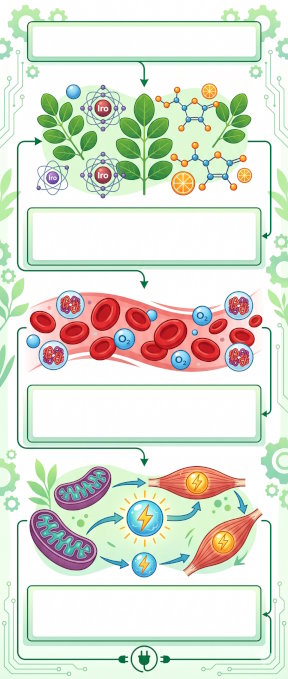 The anti-fatigue cycle of moringa Vitamin C unlocks plant-based iron to maximise its absorption Greater haemoglobin synthesis optimises the transport of oxygen to the cells More energy (ATP) is produced in a sustained manner. Reduction of muscle and mental fatigue
The phytochemical analysis of moringa leaves showed us that the plant had already "packaged" the iron together with the antioxidant flavonoids and Vitamin C necessary to protect and assimilate it. This explains why the metabolic impact of moringa on human vitality is so profound and persistent compared to other isolated alternatives.
The central role of iron in cellular oxygenation
To understand how moringa combats tiredness we must move inside the cell, specifically to the mitochondria. These organelles are the metabolic engines responsible for generating Adenosine Triphosphate (ATP), the molecule that our body uses as a universal energy currency.
This complex process of cellular respiration depends on a constant supply of oxygen. If oxygen does not reach peripheral tissues (such as muscles or the brain) in sufficient quantities, cells are forced to use anaerobic pathways, which generates lactic acid, energy inefficiency and, consequently, profound acute fatigue.
The biological vehicle in charge of transporting this oxygen through the bloodstream is haemoglobin, a protein whose structural core is iron.
The bromatological analysis of Moringa oleifera leaves reveals that they are an extraordinarily rich plant source of iron.
Vitamin C: key to the assimilation of plant-based iron
The great paradox of plant-based iron (called "non-haem" iron) is its molecular configuration, which presents greater difficulties to be absorbed by the intestinal mucosa compared to iron of animal origin.
Consuming foods rich in plant-based iron does not guarantee its systemic utilisation if it is not accompanied by a chemical facilitator.
This is where the nutritional profile of moringa makes the difference. Its leaves naturally harbour extremely high concentrations of ascorbic acid (Vitamin C). In the acidic environment of the stomach and in the intestinal lumen, Vitamin C acts as a reducing agent, transforming iron from its ferric state to its ferrous state, a much more soluble form that is assimilable by enterocytes.
Additionally, Vitamin C itself contributes to normal energy-yielding metabolism and directly helps to reduce tiredness and fatigue. Therefore, by ingesting the whole leaf, a "turnkey" anti-fatigue mechanism is introduced into the body, ensuring that the mineral is captured and used efficiently.
Proteins and electrolytes to put the brakes on muscle exhaustion
Tiredness is not merely a systemic phenomenon of lack of oxygen; it often manifests as localised muscle exhaustion. When muscle fibres lack substrates to repair themselves after physical activity, a sensation of heaviness and lethargy takes over the body.
In the macronutrient analysis of the dried moringa leaf, one can see that it contains between 22% and 29% plant protein of high biological value¹. This profile provides all nine essential amino acids, which are fundamental for tissue reconstruction.
Added to this protein matrix is an exceptional density of electrolytes, specifically potassium and calcium. Potassium is vital for repolarising the cell membrane after each nerve impulse, while calcium allows the coupling of the contractile proteins of the muscle. Both macrominerals contribute to normal muscle function, preventing biomechanical fatigue, cramps, and the weakness associated with the loss of salts.
Comparative table: nutritional density versus other vegetables
To gauge the anti-fatigue value of this plant, it is illustrative to compare the nutritional analysis of its dried leaf powder against other plant sources recognised for their nutritional density (approximate average values per 100 g):
| Nutrient / Element | Moringa oleifera (Dried Leaf) | Spinach (Dried Leaf) | Matcha Tea (Powder) |
|---|---|---|---|
| Protein (muscle repair) | 22 g - 29 g | 28 g | 30 g |
| Iron (oxygenation and energy) | 25 mg - 28 mg | 15 mg | 10 mg |
| Calcium (muscle contraction) | 2000 mg - 2200 mg | 900 mg | 400 mg |
| Vitamin C (absorption and vitality) | 15 mg - 18 mg | < 5 mg | < 2 mg |
| Fibre (digestive health) | 19 g - 24 g | 25 g | 30 g |
What effects does moringa have on the body and how long does it take to work?
The mitigation of tiredness through supplementation with this plant does not occur through a sudden exciting peak, but through a physiological progression.
This is approximately what can be expected when supplementing with moringa:
1. Adaptation and replenishment phase (days 1 to 7)
During the first week, the digestive tract begins to assimilate the high density of phytochemicals. The electrolytes present (calcium and potassium) favour intra- and extracellular cellular rehydration. On a biochemical level, the body begins to discreetly replenish iron stores (ferritin) and neutralise free radicals thanks to the action of flavonoids.
2. Oxygenation and metabolic optimisation phase (days 15 to 30)
As iron reserves stabilise, driven by natural Vitamin C, the synthesis of haemoglobin in red blood cells becomes more efficient. It is during this phase that the person begins to notice a palpable reduction in daytime asthenia, greater resistance to aerobic effort, and a decrease in the sensation of mental and physical heaviness at the end of the day.
3. Resilience and maintenance phase (long-term)
With sustained consumption, the antioxidant protection (provided by vitamins A and E in the leaf) shields cell membranes against oxidative stress resulting from a demanding pace of life. This translates into much more agile muscle recovery and the ability to maintain high energy levels without falling into chronic exhaustion.
How to take moringa: the importance of the capsule format
Compounds such as ascorbic acid (Vitamin C) and phenolic antioxidants are highly sensitive to light (photosensitive), oxygen, and high temperatures. If the leaves are dried in direct sunlight or exposed to the open air for prolonged periods, the Vitamin C degrades, breaking the metabolic synergy essential for iron absorption.
For this reason, its preservation is a critical quality factor. Encapsulation presents itself as the safest and most efficient format. By isolating the micro-milled powder inside a plant-based shell, environmental oxidation is slowed down and a precise dosage is ensured.
Opting for pure and agronomically controlled formulations, such as an organic moringa in capsules, guarantees that the leaf contains no pesticides or heavy metals that saturate the liver, and ensures that the delicate proportion of iron and vitamins reaches the digestive tract intact to exert its vitalising action.

Side effects and contraindications of moringa
The consumption of Moringa oleifera leaves has a remarkably high safety profile and excellent tolerance in the healthy adult population³. However, as it possesses a notable concentration of insoluble dietary fibre and organosulphur bioactives, excessive intake when starting its consumption can lead to mild and transient gastrointestinal discomfort, such as a laxative effect, flatulence, or stomach heaviness. To prevent these physiological reactions, the standard recommendation is to strictly respect the daily dosage indicated on the labelling and to take the capsules accompanied by food or plenty of water⁴.
Frequently Asked Questions (FAQ) about moringa and energy
1. Does moringa provide quick energy like coffee?
No. Unlike coffee, tea, or conventional energy drinks that contain caffeine or other central nervous system stimulants, moringa does not cause a rapid "peak" of excitation followed by an energy crash. Its metabolic effect is based on providing real cellular substrates (iron, Vitamin C, calcium). It provides sustained support, progressively reducing general tiredness by improving tissue oxygenation and optimising mitochondrial function, without generating nervousness or interfering with sleep.
2. Why consume moringa in capsules instead of loose powder?
When the goal is to mitigate fatigue, we need to ensure maximum absorption of iron and Vitamin C. Bulk powder, being opened and closed daily, continuously exposes its active ingredients to oxygen and light, which rapidly oxidises and degrades the natural ascorbic acid. The capsule format acts as an insulating chamber that protects the leaf's phytochemical profile until the exact moment of digestion.
Furthermore, it facilitates a standardised dosage, ensuring that each intake provides the exact amount of nutrients necessary to support energy-yielding metabolism.
Finally, consuming capsules avoids the markedly herbal and bitter taste of the leaf, facilitating its integration into the daily routine without altering the palate of meals or drinks.
3. What is the best time of day to take moringa to combat fatigue?
To maximise its benefits against tiredness, the general recommendation is to take the capsules in the morning, preferably with breakfast or lunch. Given that its mechanism of action optimises cellular oxygenation through iron and Vitamin C, ingesting it at the start of the day allows its nutrients to support you during the hours of greatest physical and mental demand. In addition, taking it accompanied by food favours the digestion of its high levels of plant fibre and prevents any discomfort in sensitive stomachs. Although it does not contain caffeine or alter the nervous system, it is usually suggested to avoid its consumption late in the day so as not to interfere with the natural cycle of preparation for sleep.
Bibliography
- Shen, Z., Chen, X., Chen, Y., et al. (2024). Moringa oleifera leaf extracts improve exercise performance in young male adults: A pilot study. Phytomedicine: International Journal of Phytotherapy and Phytopharmacology, 131, 155751.
- Lamou, B., Taiwe, G. S., Hamadou, A., et al. (2016). Antioxidant and Antifatigue Properties of the Aqueous Extract of Moringa oleifera in Rats Subjected to Forced Swimming Endurance Test. Oxidative Medicine and Cellular Longevity, 2016, 3517824.
- Stohs, S. J., & Hartman, M. J. (2015). Review of the Safety and Efficacy of Moringa oleifera. Phytotherapy Research, 29(6), 796-804.
- Asare, G. A., Gyan, B., Bugyei, K., et al. (2014). Micro- and Macroelemental Composition and Safety Evaluation of the Nutraceutical Moringa oleifera Leaves. Journal of Toxicology, 2014, 786979.
About the author
Content researched and written by the Anastore editorial team.
Reviewed and verified against scientific literature by our Nutrition and Research Department.
Find out more about our editorial policy and scientific rigour.

This article is strictly for informational purposes and does not replace the advice of a healthcare professional.