Konjac or Chitosan. What to take for weight management?
In the world of dietary fibres, there are two completely different approaches that are often confused, but which act in diametrically opposed ways:
- Blocking fats: Acting as a "magnet" for lipids (fats) in the gut.
- Generating satiety: Acting as a "sponge" that tricks the stomach.
We introduce you to two of the most studied fibres: glucomannan, extracted from an Asian tuber, and chitosan, derived from marine shells. To know which one suits you best, you must understand how they work and what hurdles they can help you overcome.
Here is a quick glance at the conclusions. Keep reading if you want to know the best way to take them, whichever you choose, and how they work.
-
Do you experience anxiety and a constant urge to snack?
If your main issue is food anxiety, constant hunger between meals, or difficulty controlling portion sizes, the physical satiety of konjac is the best choice.
-
Are you looking to improve fat metabolism?
If, on the other hand, your goal is focused on the metabolic management of lipids and maintaining a healthy blood cholesterol profile, chitosan seems the most advisable.
Konjac glucomannan to promote a feeling of satiety
Glucomannan is a polysaccharide extracted from the root of Amorphophallus konjac, a plant native to Southeast Asia that has been used for centuries in traditional Japanese gastronomy to make jelly blocks known as konnyaku.
Its main property is its huge capacity to absorb water. This fibre is made up of extremely long chains of glucose and mannose which, upon coming into contact with water, unfold their molecular structure and trap the liquid molecules, multiplying its original volume up to fifty times.
How does glucomannan work?
When you ingest konjac glucomannan capsules along with a couple of glasses of water, the capsule dissolves in the acidic environment of the stomach. Immediately, the pure fibre begins to hydrate, forming a highly viscous and dense gel.
This gel provides no calories, as human digestive enzymes lack the necessary tools to break its molecular bonds.
Its function is purely mechanical
As it expands, it gently presses against the stomach walls. This physical pressure activates the gastric mechanoreceptors, which send a signal via the vagus nerve directly to the hypothalamus (the brain's control centre), informing it that the stomach is full. The result is a natural reduction in appetite.
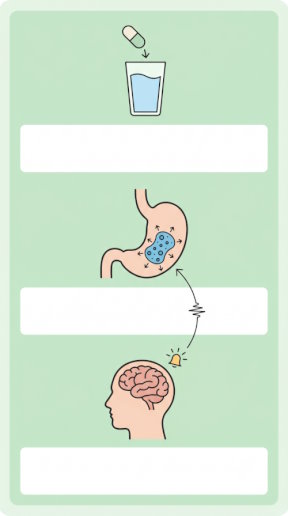 Taken with 1-2 glasses of water before a meal The fibre absorbs water and expands, taking up volume The stomach sends a satiety signal to the brain
The efficacy of this mechanical satiety is not based on guesswork, but on solidly proven evidence. The European Food Safety Authority (EFSA), known worldwide for its strict standards before approving any scientific claim, has ruled that:
-
Glucomannan helps with weight loss when following an energy-restricted diet1
However, it is not enough to take glucomannan and continue with unhelpful eating habits. This beneficial effect is only obtained within the context of an energy-restricted diet and by consuming 3 grams daily, divided into 1-gram doses, taken with 1-2 glasses of water before meals1, 2.
Glucomannan does not "burn" calories on its own, but it provides the physical satiety necessary to adhere to a caloric deficit without suffering from a constant feeling of hunger.
Extra benefit of glucomannan as a probiotic
Once the glucomannan gel leaves the small intestine and reaches the colon, it encounters our intestinal microbiota. Being a highly fermentable fibre, beneficial colonic bacteria (such as Bifidobacterium and Lactobacillus) use it as food.
-
With glucomannan we start out looking for satiety in the stomach and end up nourishing our bacterial ecosystem in the colon.
Through this fermentation process, the bacteria produce short-chain fatty acids, such as butyrate, which are essential for maintaining the health and integrity of the intestinal barrier.
How does chitosan trap fats and facilitate their expulsion?
If glucomannan bases its strategy on the physics of volume and viscosity, chitosan relies on a molecular chemistry strategy: ion exchange.
Chitosan doesn't grow in the ground; rather, it comes from the sea. It is obtained from chitin, the main component of crustacean exoskeletons (such as crabs and prawns).
For this marine chitin to be useful in the human body, it undergoes a laboratory process called deacetylation. The result is chitosan, a linear aminopolysaccharide that has a chemical peculiarity almost unique in the world of dietary fibres: it possesses a positive electrical charge.
And how can all this help us?
This is how chitosan works for weight management
Most of the lipids (fats) we consume in our diet and the bile acids our liver produces to digest them have a negative electrical charge.
-
As opposite poles of a magnet attract, when chitosan comes into contact with stomach acid, its amino groups become protonated (they acquire a very strong positive charge).
As the food chyme passes from the stomach to the small intestine, the environment changes from acidic to neutral. At this point, the chitosan forms an insoluble complex, physically trapping the dietary lipids and bile acids in a molecular network. Since the human body lacks the enzymes to digest chitosan, this conglomerate of fibre and fat travels through the entire intestine without being absorbed into the bloodstream, ultimately being excreted through the faeces.
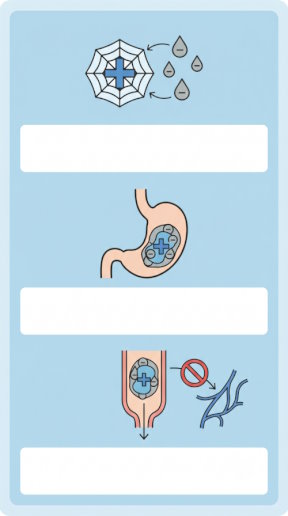 Chitosan acquires a positive charge and attracts fats (-) A compact block is formed that the body cannot digest Fats are not absorbed and are eliminated naturally
Can chitosan also help manage cholesterol?
This lipid sequestration has a very interesting physiological impact beyond caloric control. By trapping bile acids and eliminating them from the body, the liver is forced to make new bile. To do so, it needs raw material: cholesterol. Therefore, the liver extracts circulating cholesterol from the blood, resulting in a reduction of serum cholesterol levels.
-
Chitosan consumption contributes to the maintenance of normal blood cholesterol levels1,3.
The condition for this benefit to be real and verifiable is a daily intake of 3 grams.
Konjac vs. Chitosan: Comparative analysis
To clearly visualise how these two fibres operate in our body, it is very useful to contrast their technical characteristics. Both are excellent polysaccharides, but their practical application is substantially different.
| Konjac Glucomannan | Chitosan | |
|---|---|---|
| Origin | Plant-based (root of Amorphophallus konjac) | Animal/Marine (crustacean exoskeleton) |
| Chemical structure | Extremely high molecular weight hydrocolloid | Deacetylated aminopolysaccharide (with electrical charge) |
| Mechanism of action | Physical: absorbs water and forms an expansive viscous gel. | Chemical: ion exchange that traps negative lipids. |
| Main organ of action | Stomach (distension and delayed emptying) | Intestine (binding to bile acids and lipids) |
The importance of eating habits
It is essential to approach these supplements with honesty. Neither glucomannan will make you lose weight if you continue maintaining a caloric surplus based on ultra-processed foods, nor will chitosan compensate for excessive consumption of saturated fats (burgers dripping in sauce, late-night pizzas, sugary soft drinks, …) that are detrimental to your cardiovascular health. They are tools that can facilitate the process of changing habits, but they do not replace balanced eating habits.
How much water should you drink when taking konjac or chitosan?
-
Insoluble fibre needs water to function, but soluble fibre imperatively demands it.
Glucomannan cannot form its characteristic three-dimensional gel without water (H₂O) molecules with which to establish hydrogen bonds. Taking the capsule with just a sip of water will limit its expansion in the stomach, drastically reducing its satiating efficacy and causing it to hydrate later in the intestinal tract, which is suboptimal.
Similarly, chitosan requires a fluid intestinal transit to excrete the lipid complexes it forms, and dehydration would slow down this process.
Precautions and contraindications when taking konjac or chitosan
Both fibres possess a very high safety profile, but they do require certain precautions. Glucomannan can cause mild gastrointestinal discomfort during the first few days of adaptation.
Chitosan has a strict contraindication: as it is derived from crustacean exoskeletons, it is strictly forbidden for people with a shellfish allergy. Furthermore, due to its great capacity to sequester lipids, it can interfere with the proper absorption of fat-soluble vitamins (A, D, E, and K) and certain lipophilic medications. For this reason, pregnant or breastfeeding women, or individuals on chronic medication (such as anticoagulants or hormonal treatments) should avoid it, or consume it solely under strict medical supervision, always separating its intake by at least two hours from any pharmaceutical drug.
Bibliography
- COMMISSION REGULATION (EU) No 432/2012 of 16 May 2012 establishing a list of permitted health claims made on foods, other than those referring to the reduction of disease risk and to children's development and health.
- Zalewski, B. M., Chmielewska, A., & Szajewska, H. (2015). The effect of glucomannan on body weight in overweight or obese children and adults: a systematic review of randomized controlled trials. Nutrition, Metabolism and Cardiovascular Diseases, 25(8), 703-712.
- Moraru, C., Mincea, M., Frandes, M., Timar, B., & Ostafe, V. (2018). A Meta-Analysis on Randomised Controlled Clinical Trials Evaluating the Effect of the Dietary Supplement Chitosan on Weight Loss, Lipid Parameters and Blood Pressure. Marine Drugs, 16(12), 465.
About the author
Content researched and written by the Anastore editorial team.
Reviewed and verified against scientific literature by our Nutrition and Research Department.
Find out more about our editorial policy and scientific rigour.

This article is strictly for informational purposes and does not replace the advice of a healthcare professional.