
How glucose influences the post-meal slump and what berberine can do about it
Why do you feel lethargic or tired after eating?
Many simply put it down to "digesting", but why does this drowsy effect occur? What relationship does berberine have with it?
That sudden fatigue is not laziness or a lack of accumulated sleep. It is a response from your body trying to manage what you have just eaten. Simply put, your body is working in overdrive to balance your blood sugar levels.
When the internal mechanisms that regulate our energy do not work at peak efficiency, we experience these peaks and crashes (moments of euphoria followed by slumps), which can ultimately affect our general well-being.
Berberis aristata (rich in berberine) and glucose
In recent years, much has been said about berberine for various reasons. One of the main properties of the root extract of the Berberis aristata plant (rich in berberine) is its usefulness in helping to improve blood glucose control1.
Comparison between a body with balanced glucose and one without
So that you can see in practical terms what could happen in your day-to-day life, we have prepared this simple comparative table. This is how a body with a good glucose balance feels compared to one that is starting to struggle:
| What happens in your body | When there is balance (Normoglycaemia) | When the metabolism struggles |
|---|---|---|
| Cellular response | The doors of the cell open easily. Glucose enters and gives you vitality. | Resistance. It is difficult to open the doors and glucose remains in the blood. |
| Sensation after eating | Stable and long-lasting energy. You feel satiated and light. | Peaks of euphoria followed by lethargy, drowsiness and sweet cravings. |
| Liver's work | Releases energy in a controlled manner at night. | Produces too much glucose, sometimes causing you to wake up with high blood sugar. |
| Reserve management | Sugar is stored in the muscle for when you move. | Excess sugar that is not used up is converted into body fat. |
How does our body assimilate food and what is glucose used for?
When you eat foods rich in carbohydrates (such as bread, potatoes, rice or fruit), your body begins to break them down from the very first bite thanks to your saliva. As that food reaches your stomach and then your intestine, those carbohydrates are transformed into much smaller pieces, mainly into a molecule called glucose.
This glucose is your body's main fuel. From the intestine, it passes into the bloodstream. But here is the key detail:
-
Glucose should not just float around in the blood. Its mission is to enter the cells of your muscles, your liver and your brain to give you energy.
For glucose to enter the cell and leave the blood, it needs someone to open the door. That "someone" is insulin, a hormone produced by your pancreas.
How does insulin act so that you assimilate glucose correctly?
We can imagine that every cell in your body has a lock, and insulin is the exact key. When you eat and your blood sugar rises, your pancreas releases these keys. The insulin travels, opens the cellular locks, the glucose enters and your blood levels return to normal. Everyone is happy.
The problem arises when, due to a sedentary lifestyle, prolonged stress, poor diets or simply the passing of the years, those locks become "rusty" or resistant. The key (insulin) no longer turns well. Because the door does not open completely, the glucose gets stuck in the blood. The pancreas, seeing this, panics and produces even more keys, creating a vicious cycle of a lot of insulin and a lot of circulating sugar. It is here that fatigue, tiredness and metabolic imbalances make their appearance.
This is how berberine works to help improve blood glucose control
Having stable glucose levels is vital so as not to feel those energy slumps and, above all, to age with a better quality of life. A constantly high sugar level acts as a kind of "sandpaper" inside the blood vessels, generating oxidative stress.
Relationship between berberine and the AMPK enzyme
In our cells there is an enzyme, a type of protein, called AMPK. When you do intense physical exercise or when you go a few hours without eating, your body uses up energy. When reserves drop, AMPK is "switched on". Upon activation, this sensor gives a very clear order to your entire organism: "We are on reserve, we need efficient energy and to stop storing".
What does the body do then?
- It opens more doors in muscle cells to absorb glucose from the blood faster.
- It halts the production of new fats.
- It starts using accumulated fat reserves as fuel.
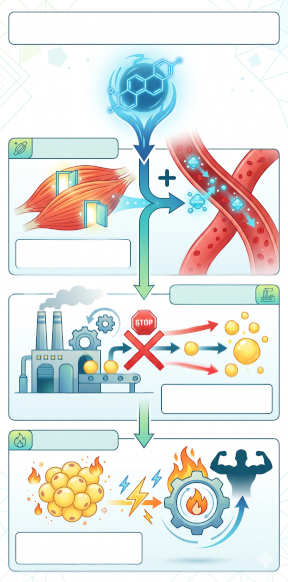 WHAT DOES THE BODY DO WHEN THE AMPK ENZYME IS ACTIVATED? Improves glucose absorption Halts the production of new fats Uses fat reserves as energy
It is now known that certain botanical compounds such as berberine have the ability to activate this AMPK switch without the need to be doing exercise at that precise moment2,3. By switching on this sensor, the body enters a much more efficient working mode for managing sugars.
How berberine acts in the body
Studies indicate that, to help improve blood glucose control, berberine works as a team on three different fronts:
- In your digestion: It helps to slow down the rate at which carbohydrates are broken down in your intestine. By digesting more slowly, sugar enters your blood gradually, like a gentle drip, rather than doing so all at once like a tsunami.
- In your cells: By activating the AMPK switch, it helps to "oil" the locks we discussed earlier. Your cells become more sensitive and receptive to your own insulin.
- In your liver: Your liver is like a pantry that releases sugar when you haven't eaten for hours (for example, while you sleep). Sometimes, if the metabolism is deregulated, the liver releases sugar into the blood even if you don't need it. This active compound helps to calm the liver so that it only releases glucose when it is truly necessary.
Daily habits to optimise glucose use
To get the most out of your metabolism, in addition to support like berberine, it is necessary to start with a lifestyle that considers these three pillars:
- Movement: Muscle tissue is your body's biggest glucose consumer. When exercising, especially strength training (lifting some weight, doing press-ups, using resistance bands), your muscles absorb sugar from the blood automatically, without even needing insulin.
- Fibre on every plate: Start your meals with a portion of vegetables. Fibre creates a kind of "net" in your stomach that physically slows down the absorption of the carbohydrates you eat afterwards. It is a simple trick that perfectly complements the digestive slowing effect of plant extracts.
- Give your digestion a break: Try not to have dinner too late or eat large amounts of simple carbohydrates just before going to sleep. At night, our body is prepared to repair, not to manage large sugar spikes.
Precautions and contraindications of berberine
Although it is a naturally derived compound and generally very safe for healthy adults, common sense and certain precautions must be taken.
It is possible that during the first few days of use, some mild digestive discomfort may be experienced, such as a little constipation, wind, or loose stools. The body needs to adapt, so it is usually recommended to start gradually and always take it with meals.
As a precaution, pregnant or breastfeeding women should not take it, as this alkaloid can reach the foetus or pass into breast milk. As it interacts with the liver, if you are taking medication, consult your doctor to prevent it from interfering with your treatments.
Better if it is a standardised berberine extract
Understanding how insulin works, what glucose is used for, and how sensors like AMPK regulate our energy gives you the power to make better decisions. Proper habits and knowing how our body works allow us to use the tools we have at our disposal to balance those irregularities that can appear in our day-to-day lives.
Opting for a standardised berberine extract sourced from the Berberis aristata root ensures a constant and high-purity supply of this active compound.
Bibliography
- Extracted from the EFSA health claims application list, under evaluation (ID4363).
- Efficacy of berberine in patients with type 2 diabetes mellitus. Yin, J., Xing, H., & Ye, J. (2008). Metabolism, 57(5), 712-717.
- Berberine in the treatment of type 2 diabetes mellitus: a systemic review and meta-analysis. Dong, H., Wang, N., Zhao, L., & Lu, F. (2012). Evidence-Based Complementary and Alternative Medicine, 2012, 591654.
About the author
Content researched and written by the Anastore editorial team.
Reviewed and verified against scientific literature by our Nutrition and Research Department.
Find out more about our editorial policy and scientific rigour.

This article is strictly for informational purposes and does not replace the advice of a healthcare professional.