
Is it effective to take glucosamine and chondroitin sulphate together for your joints?
When your joints send you warning signs
- Do you feel some stiffness in your knees or hands when taking your first steps in the morning?
- Do you notice discomfort or hear little "clicks" when you go up and down the stairs?
- Have you had to lower the intensity of your physical activity or walks because your joints no longer respond with the same ease as before?
If you have answered yes to any of these questions, you are experiencing a very common reality. From the age of 45 or 50, or even earlier if you have practised high-impact sports throughout your life, it is common for joints to start losing some of their natural agility.
Frequently, we assume that these types of signs are simply an inevitable toll we must pay for the passage of time or for maintaining an active lifestyle.
Understanding how our joints work on the inside allows us to give them the right tools. For the whole system to move smoothly and without discomfort, it needs its structural components to remain well-nourished and hydrated.
Glucosamine and chondroitin sulphate food supplements have long been presented as champions for joints, but do they really have a beneficial effect on them?
Causes of articular cartilage wear and tear and how to maintain its wellbeing
What are joints like?
At the exact point where two bones meet (such as in the knee, elbow or hip), the bone ends do not clash directly against each other. They are covered by a firm, smooth and flexible tissue called articular cartilage. Furthermore, this entire space is wrapped and bathed in synovial fluid, a thick fluid that acts like the lubricating oil of an engine.
Cartilage has a very important biological peculiarity: it has no blood vessels. Lacking a direct blood supply, it does not receive nutrients in the same way as muscles or skin do. Its only way to feed itself is by absorbing the nutrients floating in the synovial fluid, and it does this through physical movement itself. When we walk or move, the joint acts as a mechanical pump that pushes nutrients into the cartilage.
Why do joints deteriorate?
Over the years, due to factors such as being overweight, repetitive movements at work, a sedentary lifestyle or sports wear and tear, this protective tissue undergoes a physiological deterioration process.
The cartilage gradually loses its natural ability to retain water and renew its cells. As it loses water, it becomes thinner, less elastic and more fragile. As a direct result, cushioning fails and friction between the structures increases, giving rise to that bothersome feeling of stiffness or lack of mobility.
Maintaining the wellbeing of this tissue requires a holistic approach. Having a healthy weight is vital so as not to overload the structure, as well as carrying out gentle strength exercises that help the muscles support the joint. Alongside these habits, ensuring that the body has the key nutrients to form and maintain cartilage is a fundamental pillar to prolong quality of life and physical comfort in the long term.
What is glucosamine and how does it work in the body?
Glucosamine is a natural substance that our body produces on its own. It is one of the basic building blocks that the body uses to make cartilage. Without a sufficient amount of available glucosamine, the body simply does not have the raw material it needs to renew and maintain in good condition the tissue that protects the ends of the bones.
But its job doesn't end there. Glucosamine is also fundamental for joint cells to produce hyaluronic acid. This acid is the star component of the synovial fluid. By helping to maintain optimal levels of this fluid, glucosamine contributes directly to improving the general lubrication of the joint, making movements smoother again and reducing the wear caused by daily friction.
What is chondroitin sulphate and what is it for?
If glucosamine is in charge of manufacturing the base materials for the joint, chondroitin sulphate is responsible for giving them their final shape, flexibility and resistance. Chondroitin is one of the most abundant molecules within the structure of human cartilage.
Chondroitin works exactly like a sponge. Its molecular structure has the natural ability to attract and retain huge amounts of water within the cartilage matrix. This retained water is what provides the cartilage with its ability to absorb impacts. Thanks to chondroitin, the cartilage can compress when we jump or walk, and immediately recover its original shape without breaking.
In addition to its "shock-absorbing sponge" function, chondroitin sulphate plays a fundamental protective role. Inside the joints there are certain enzymes (biological substances) which, when out of balance, dedicate themselves to degrading and destroying old cartilage. Chondroitin helps to regulate this environment, keeping these destructive enzymes at bay and favouring a healthy ecosystem where the cartilage can be preserved in better condition over time.
Benefits of combining glucosamine and chondroitin for joints
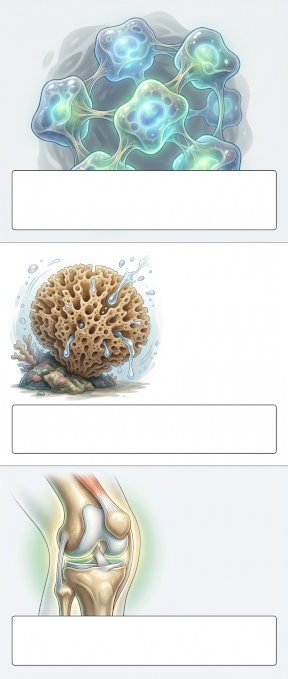 Glucosamine: Provides the key nutrients to form and renew cartilage Chondroitin: Works like a sponge. Retains water and absorbs impactsSynergy: Together they achieve an elastic, lubricated and protected joint
Knowing this, it is very common to wonder if it is necessary to take both substances together or if it would be enough to choose just one.
Through different studies it seems clear that there is significant teamwork (synergy) when they are combined, since each provides complementary benefits and they operate in different areas of the joint1.
While glucosamine takes on the role of stimulating the production of new tissue and providing the necessary lubrication through the synovial fluid, chondroitin sulphate is in charge of assembling that tissue, guaranteeing that it retains the necessary water to be a good shock absorber and protecting it against natural degradation.
By combining both nutrients, we are not only providing the bricks, but also the structure and protection, offering comprehensive support for long-term joint wellbeing3.
| Compound | Main function | Key joint benefit |
|---|---|---|
| Glucosamine | Provides basic building materials. | Improves tissue lubrication and renewal. |
| Chondroitin | Acts as a sponge retaining water. | Provides elasticity and resistance to impacts. |
| Combination | Simultaneous teamwork. | Complete support for everyday comfort and mobility. |
How long does it take to notice the effects of glucosamine and chondroitin sulphate?
Unlike other products designed to mask a symptom immediately and temporarily, glucosamine and chondroitin are structural nutrients. This means that the body needs time to assimilate, process and physically incorporate them into the joint tissues.
As cartilage is a tissue with a slow metabolism, the benefits are not perceived overnight. The general recommendation based on scientific evidence is to maintain a daily and constant intake for a period of at least 6 to 8 weeks to start noticing significant improvements in mobility and in the reduction of stiffness. To stabilise physical wellbeing, it is advisable to maintain prolonged consumption patterns over several months.
Buying a good glucosamine and chondroitin sulphate supplement. How to choose one
The current market is full of options, but it is crucial to know that not all products offer the same degree of purity, nor does the body assimilate them in the same way. Reading the labels and understanding the origin of the ingredients makes the difference between an effective product and one that does not meet expectations. Below, we detail the key points for making a wise choice.
Plant-based glucosamine vs animal glucosamine
Historically, glucosamine has been obtained by crushing the shells of crustaceans and shellfish, which can pose an allergy problem and a greater environmental impact. Current biotechnology allows glucosamine to be extracted through a natural fermentation process, achieving a 100% plant-based product. Opting for a plant-based Glucosamine HCL (D-glucosamine hydrochloride) guarantees a supplement of maximum purity, fully suitable for vegans and with excellent assimilation by the body, without resorting to animal sources.
-
Traditionally, to supply the global demand for glucosamine supplements, thousands of tonnes of shrimp, lobster and crab shells had to be crushed annually. Nowadays, thanks to bacterial fermentation of biotechnological origin, we can obtain 100% plant-based glucosamine, which is much purer and has no impact on marine ecosystems.
The purity of chondroitin sulphate
The origin of chondroitin is, if possible, even more decisive. It can be obtained from bovine, porcine or marine origins. Studies show that cartilage from aquatic sources has a structure that is much more akin to that of humans, facilitating superior absorption and better metabolic utilisation. Choosing a Chondroitin sulphate of marine origin is synonymous with premium quality, ensuring purity levels above 90% and avoiding the risks associated with terrestrial livestock farming.
Clean formulation
Always make sure that the capsules coating the product are of plant origin (such as hydroxypropyl methylcellulose) and check that the ingredient list does not contain additives, colourings or synthetic excipients that add no nutritional value to the supplement.
Side effects and contraindications of glucosamine and chondroitin sulphate
Since they are components that already exist naturally in our body, glucosamine and chondroitin supplements have a very high safety profile and are very well tolerated by the vast majority of adults2. The few documented side effects tend to be mild and transient, usually limited to minor digestive discomfort, a heavy stomach or occasional variations in intestinal transit.
Who should not take this combination?
As a general precaution, there are some profiles who should consult their doctor before starting to take this type of supplement:
- People taking anticoagulant medication, due to possible minor interactions with coagulation.
- People with diabetes or prediabetes, as glucosamine is a sugar derivative and routine medical monitoring is advisable.
- Patients diagnosed with severe asthma or who require diets with a strict control of minerals such as sodium or potassium.
- Pregnant women, nursing mothers and minors, due to the lack of specific studies in these population groups.
Bibliography
- Combined chondroitin sulfate and glucosamine for painful knee osteoarthritis: a multicentre, randomised, double-blind, non-inferiority trial versus celecoxib. Hochberg, M. C., Martel-Pelletier, J., Monfort, J., Möller, I., Castillo, J. R., Arden, N., Berenbaum, F., Blanco, F. J., Conrozier, T., Herrero-Beaumont, G., McAlindon, T., Raynauld, J. P., Stiglic-Vignjevic, T., Zegels, B., Gomis, A., Vergés, J., & Pelletier, J. P. (2016). Annals of the rheumatic diseases, 75(1), 37–44.
- The Safety and Efficacy of Glucosamine and/or Chondroitin in Humans: A Systematic Review. Zhu, X., Sang, L., Wu, D., Rong, J., & Jiang, L. (2023). Nutrients, 15(19), 4153.
- Chondroitin sulfate and glucosamine combination in patients with knee and hip osteoarthritis: A long-term observational study in Russia. Lila, A. M., Alekseeva, L. I., & Taskina, E. A. (2023). World journal of orthopedics, 14(6), 446–457.
About the author
Content researched and written by the Anastore editorial team.
Reviewed and verified against scientific literature by our Nutrition and Research Department.
Find out more about our editorial policy and scientific rigour.

This article is strictly for informational purposes and does not replace the advice of a healthcare professional.