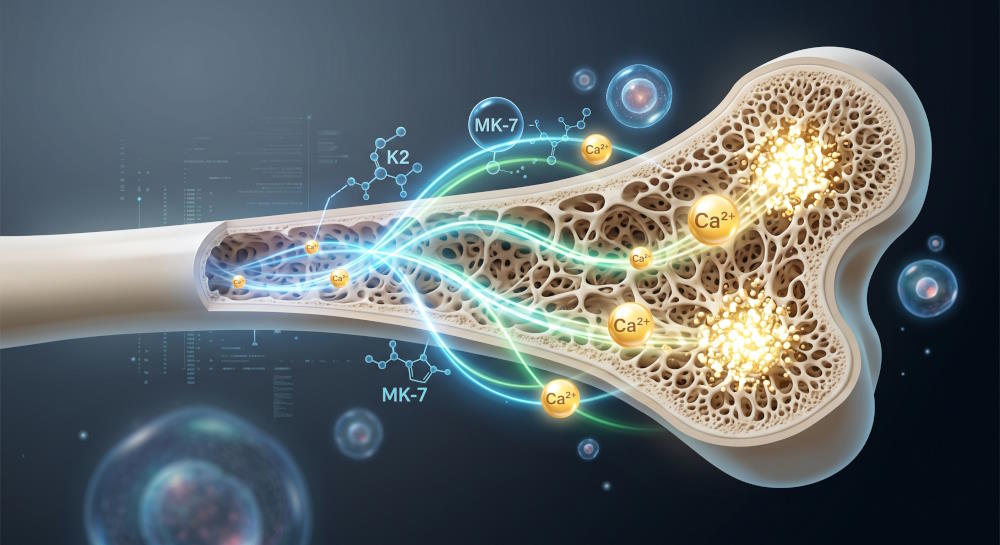
Vitamin K2: how it contributes to the maintenance of normal bones
Quick fact
Did you know that consuming large amounts of calcium does not, on its own, guarantee that this mineral correctly reaches your bones?
Once in the bloodstream, calcium needs a sort of "biological GPS" to know exactly where it should be deposited and, equally importantly, which tissues it should avoid.
For decades, nutritional advice for maintaining a strong bone structure has focused almost exclusively on two elements: calcium and, more recently, vitamin D. However, there is a fundamental piece that has gained significant relevance in recent scientific literature: vitamin K2.
Let's look at exactly how this nutrient works, why the modern diet often falls short in providing it, and how specific variants of this vitamin can be more beneficial for the maintenance of our bones.
What is vitamin K2 and why is it different from vitamin K1?
When we talk about vitamin K, we are actually referring to a family of fat-soluble compounds (which dissolve in fats) that share a similar chemical structure. However, their functions in the body are markedly different depending on their exact form. The two main forms present in food are vitamin K1 and vitamin K2.
-
Vitamin K1
Scientifically known as phylloquinone, it is the most abundant form in our diet. It is mainly found in green leafy vegetables (such as spinach, broccoli, and kale) and its main, most well-known function is linked to blood clotting. In fact, the letter "K" comes from the German word Koagulation.
-
Vitamin K2 (menaquinone)
It is primarily synthesised through bacterial fermentation and is found in animal-sourced foods or fermented foods. Unlike K1, which is rapidly processed in the liver to manage clotting, K2 remains in the bloodstream for longer and is distributed to other tissues in the body, such as blood vessels and, crucially, bones1.
To better understand their differences, we can look at the following comparative table:
| Characteristic | Vitamin K1 (Phylloquinone) | Vitamin K2 (Menaquinone) |
|---|---|---|
| Main source | Green leafy vegetables (spinach, chard). | Fermented foods and animal-sourced products. |
| Predominant function | Synthesis of clotting factors in the liver. | Calcium distribution: bone maintenance and vascular health. |
| Origin | Plant photosynthesis. | Bacterial fermentation. |
| Time in blood | Short (eliminated within a few hours). | Prolonged (especially some variants like MK-7). |
How vitamin K contributes to the maintenance of normal bones2
Bone is not an inert tissue; it is a living and dynamic organ that is constantly being broken down and rebuilt. Two main types of cells participate in this remodelling process: osteoclasts (which remove old bone tissue) and osteoblasts (which form new bone tissue).
Osteoblasts are responsible for producing a fundamental protein called osteocalcin. This protein has a single mission: to bind to the calcium available in the blood and fix it into the bone matrix, giving it hardness and strength.
The carboxylation process
This is exactly where vitamin K2 comes into play. When osteoblasts produce osteocalcin, it is in an inactive state. We could imagine osteocalcin as a taxi with the mission of picking up passengers (calcium) and taking them to their destination (the bone). However, newly produced, this taxi doesn't have the keys in the ignition; it cannot bind to calcium.
Vitamin K2 acts as an enzymatic cofactor. Through a biochemical process known as carboxylation, vitamin K2 alters the chemical structure of osteocalcin (converting glutamic acid residues into gamma-carboxyglutamic acid). This structural change is the equivalent of "starting the engine". Only in its carboxylated form, that is, activated by vitamin K, does osteocalcin acquire the ability to bind tightly to calcium and fix it into the bone structure.
Without an adequate amount of vitamin K, much of the osteocalcin remains inactive (known as undercarboxylated osteocalcin), reducing the efficiency with which the body uses dietary calcium for bone mineralisation3.
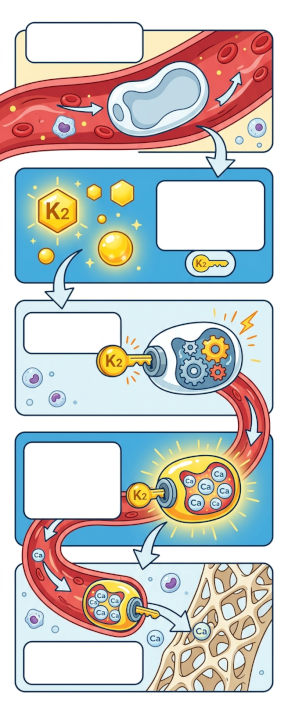 Inactive osteocalcin Vitamin K2
MK-7Activated proteinCalcium bindingBone mineralisation
Properties of the MK-7 (Menaquinone-7) variant of vitamin K2
Within the vitamin K2 family, there are several molecular forms classified according to the length of their side chain (a "tail" of isoprene molecules attached to their central structure). They are denoted as MK-n, where the "n" indicates the number of isoprene units. The two most studied and relevant forms for human consumption are MK-4 and MK-7.
MK-7 has greater bioavailability
The fundamental difference between the two lies in their behaviour once they enter the human body. MK-4 has a very short half-life; this means the body metabolises and eliminates it within a couple of hours.
In contrast, Menaquinone-7 (MK-7) has a longer side chain, giving it a superior lipophilic quality.
What does this mean in practical terms? That MK-7 remains active in the bloodstream for much longer (up to 72 hours). By remaining in circulation for several days, it allows peripheral tissues (like bones) to have continuous access to the vitamin to activate the aforementioned proteins.
Less MK-7 is needed than MK-4
Thanks to this high bioavailability, large amounts of MK-7 are not required to achieve a stable blood level. In fact, contemporary nutritional studies observe optimal physiological effects with doses measured in micrograms4. It is common nowadays for high-quality food supplement formulations to offer precise concentrations to cover these daily requirements, such as a vitamin K2 with the MK-7 variant 105 micrograms.
Foods with vitamin K2: why is there a deficiency in the modern diet?
If vitamin K2 is so important for bone maintenance, it is logical to wonder why it is not discussed as much in traditional dietary advice. The answer lies in the changes the human diet has undergone over the last century.
Menaquinone is synthesised almost exclusively by specific bacteria. Therefore, to obtain it naturally, we must turn to foods that have undergone a bacterial fermentation process or to products from animals that, in turn, have consumed green grass (rich in K1) and had their own digestive bacteria convert it into K2.
Foods rich in Vitamin K2:
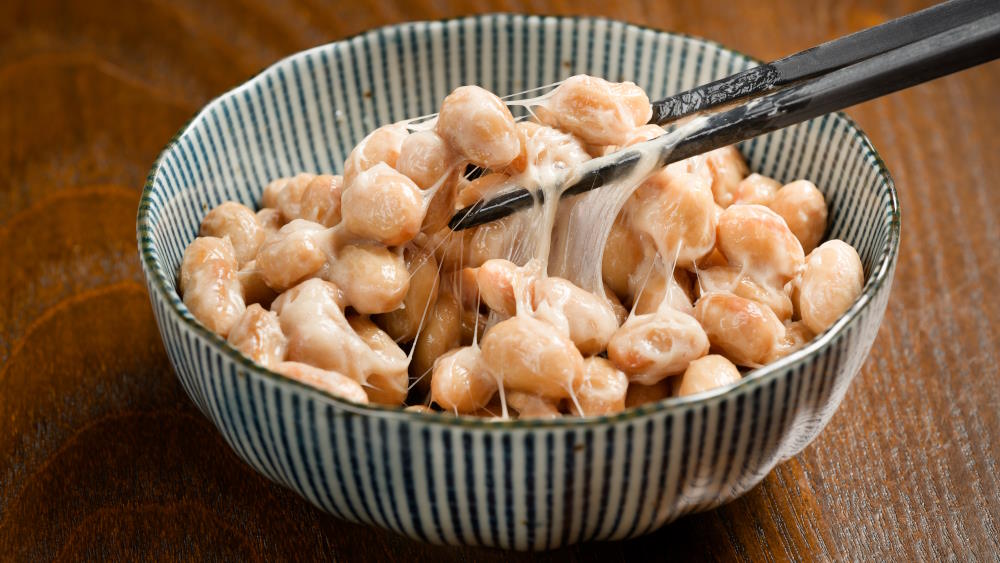
- Natto: It is, by far, the richest food source of MK-7 discovered to date. It is a traditional Japanese dish made from soybeans fermented with the bacterium Bacillus subtilis. However, its sticky texture and extremely strong smell, similar to ammonia, make it very unpopular outside of Japan.
- Fermented cheeses: Certain traditional cheeses such as Gouda, Edam, or Brie contain moderate amounts of MK-n. The concentration depends entirely on the type of bacterial culture used in the curing process, not the milk itself.
- Animal fats: Butter, egg yolks, and certain livers (such as goose liver) mainly contain the MK-4 variant.
The problem of food industrialisation regarding vitamin K2 consumption
The decline in vitamin K2 consumption in the West coincides with the advent of refrigeration and industrial agriculture. Before the invention of fridges, fermentation was one of the main methods for preserving food, which indirectly provided beneficial bacteria and compounds like menaquinone.
Furthermore, today, much of our livestock is fed grain-based feed rather than grazing outdoors. An animal that does not consume fresh grass (the primary source of phylloquinone or K1) lacks the necessary raw material to synthesise K2 in its digestive system, resulting in meat and dairy products with a much poorer nutritional profile for this vitamin than a century ago.
This combination of dietary factors explains why bone maintenance often relies on nutritional strategies that seek to reintroduce this molecule in a controlled and standardised manner.
Contraindications of vitamin K2 and who should not take it
Vitamin K2 is a nutrient that is part of our natural metabolism and, in standard doses, has a good safety profile. As it is an activator of endogenous proteins rather than a direct stimulant, the body only uses the amount necessary to carboxylate osteocalcin, naturally eliminating or storing the rest. Side effects are extremely rare in healthy individuals.
However, there is one fundamental restriction that must be strictly observed:
- Users of anticoagulant medications: People who are undergoing treatment with oral vitamin K antagonist anticoagulants must not start supplementing with any form of vitamin K without the authorisation and strict supervision of their medical specialist or haematologist. Although the MK-7 variant plays a lesser role than K1 in hepatic clotting factors, any external supply of the vitamin K family can alter the medication's effectiveness, compromising the stability of the treatment.
For the rest of the healthy adult population, postmenopausal women, or young people looking to look after their bone health, the dietary use of menaquinone-7 is well tolerated.
Bibliography
- Vitamin K2 Needs an RDI Separate from Vitamin K1. Akbulut, A. C., Pavlic, A., Petsophonsakul, P., Halder, M., Maresz, K., Kramann, R., & Schurgers, L. (2020). Nutrients, 12(6), 1852.
- COMMISSION REGULATION (EU) No 432/2012 of 16 May 2012 establishing a list of permitted health claims made on foods, other than those referring to the reduction of disease risk and to children's development and health.
- Proper Calcium Use: Vitamin K2 as a Promoter of Bone and Cardiovascular Health. Maresz, K. (2015). Integrative Medicine: A Clinician's Journal, 14(1), 34–39.
- Three-year low-dose menaquinone-7 supplementation helps decrease bone loss in healthy postmenopausal women. Knapen, M. H. J., Drummen, N. E., Smit, E., Vermeer, C., & Theuwissen, E. (2013). Osteoporosis International, 24(9), 2499–2507.
About the author
Content researched and written by the Anastore editorial team.
Reviewed and verified against scientific literature by our Nutrition and Research Department.
Find out more about our editorial policy and scientific rigour.

This article is strictly for informational purposes and does not replace the advice of a healthcare professional.