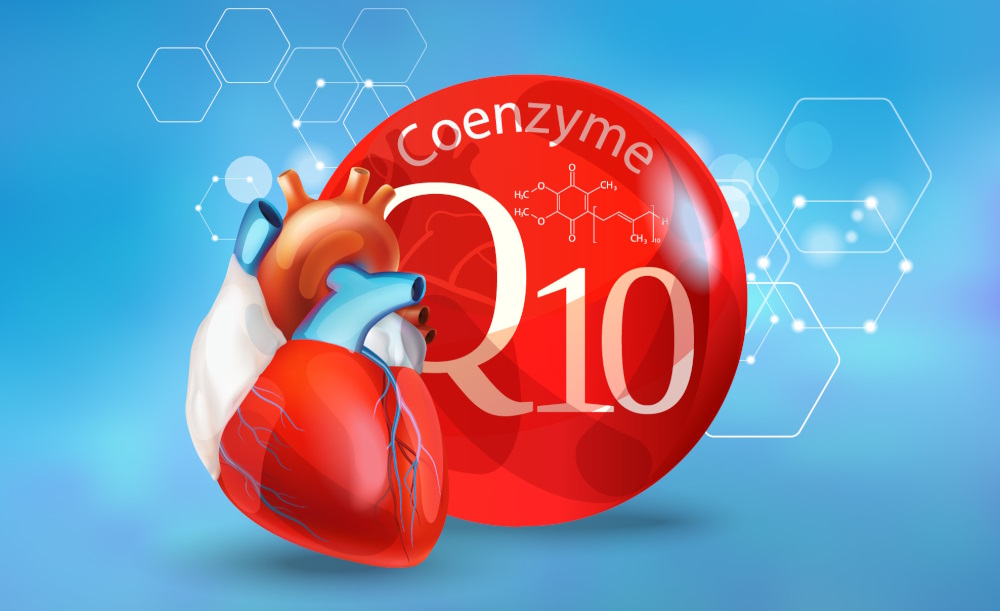
Coenzyme Q10: why we have two formulations, 40mg and 100mg (and why more does not mean better)
We all want to maintain a good energy level to face the day-to-day. Whether it is to perform well at work, enjoy sport or simply keep up with our routine, our body needs its internal gears to function optimally.
But needs are not the same for everyone. What a 30-year-old seeking daily support requires is very different from what a 50-year-old wanting to compensate for the natural wear and tear of time needs. When designing a food supplement, this reality presents us with a very interesting challenge: avoiding a "one-size-fits-all" approach.
Did you know...?
Your body is a factory capable of producing its own Coenzyme Q10, but this capacity has an "expiry date". It reaches its peak performance around the age of 20, and from then on, it begins to decrease little by little. In fact, upon passing 60 years of age, the amount of this molecule in organs that expend a lot of energy, such as the heart, may have halved1.
Let us look simply at how this molecule really works in your organism and why at Anastore, from a formulation point of view, we have proven that an excellent way to nutritionally support the body is by offering two very specific options: 40 mg and 100 mg.
What exactly is Coenzyme Q10?
We often hear Coenzyme Q10 spoken of as if it were a vitamin, but strictly speaking, it is not. Vitamins are substances that our body does not know how to manufacture and that we are obliged to seek in food. Ubiquinone (which is the technical name for Q10) is indeed manufactured in our own liver.
What is coenzyme Q10 for?
To understand its function, imagine that your cells are small cars and mitochondria are their engines. Mitochondria are responsible for taking nutrients from what we eat and transforming them into ATP, which is the real "fuel" the body uses to move, think or breathe.
Where does Coenzyme Q10 come in here? It is like the spark plug of that engine. It helps the spark to jump and the energy to flow without interruptions. If there is a small amount, the engine keeps running, but it struggles more to start and performs less efficiently.
In addition to providing that energetic "spark", ubiquinone works overtime as an antioxidant. On a biological level, the ubiquinone present in our organism exerts antioxidant properties, participating in cellular protection against oxidative stress produced by stress, pollution or the simple passage of time2.
Foods with Coenzyme Q10: do we reach the minimum with food alone?
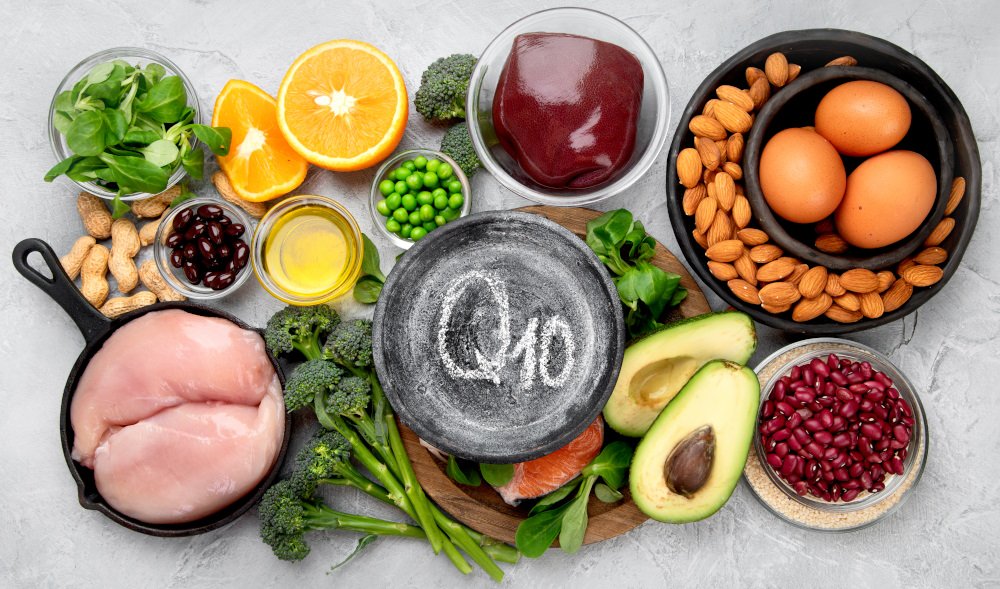
When we consider whether it is necessary to take a food supplement, the first question should always be: can I get this from my normal diet? The short answer is yes, but with important nuances.
Amount of coenzyme Q10 in food
Ubiquinone is found mainly in protein and fat-rich foods. Here is an idea of what a common diet provides:
| Food (per 100 grams) | Coenzyme Q10 |
|---|---|
| Beef or pork heart | 11 - 20 mg |
| Fresh sardines or herring | 1.5 - 3 mg |
| Roasted peanuts | 2.5 - 3 mg |
| Virgin olive or soya oil | 1 - 2 mg |
| Boiled broccoli or cauliflower | 0.5 - 0.8 mg |
If you look at the numbers, a normal and balanced diet could provide between 3 and 6 milligrams a day. For a young and healthy person, this is good support for the production their own liver already carries out.
But what happens when we want to reach amounts of 40 mg or 100 mg because our body no longer manufactures as much? The logistics become complicated.
-
You would have to eat three kilos of sardines a day or almost four kilos of peanuts to get 100 milligrams of coenzyme Q10.
Careful with cooking temperature
Furthermore, there is another problem in the kitchen: heat. Q10 is quite a delicate molecule. If you fry fish at high temperatures or roast it for a long time, a large part of that coenzyme is destroyed before reaching your stomach. Because of all this, when there is a real need to increase levels, food supplements become a very practical tool.
Why at Anastore we decided to create two formulations of coenzyme Q10: 40mg and 100mg (and why more does not mean better)
When we sat down to study how to provide this molecule effectively, we saw that the market often offers products with extremely high amounts (300 mg, 500 mg...) in a single tablet. However, the human intestine has an absorption limit.
-
A higher amount of coenzyme Q10 does not mean it is better for you
Giving the body much more than it can process at once only serves for the excess to be eliminated without being utilised.
When analysing the nutritional studies on how our cells change with age and lifestyle, we realised that the real demand is divided into two main situations. Therefore, it makes much more sense to offer the body exactly what it needs at each stage. Thus, the two formulations we focus on were born.
Coenzyme Q10 40 mg: daily support for maintenance
Think of a person between 25 and 40 years old. Their body still produces a good amount of ubiquinone. However, the current pace of life is not always easy. High-stress days at work, weeks where we do not eat as well as we should, or exercise routines at the gym cause the body to expend its antioxidant reserves a little faster than normal.
At this stage, the goal is not to give the body an enormous amount, because it does not really need it. What we are looking for is to provide it with a "safety net".
The amount of 40 milligrams daily is designed exactly for that: preventative maintenance. It is an extra aid that accompanies your metabolism's natural rhythm without saturating it. By opting for a moderate dosage, like the one offered by a 40 mg coenzyme Q10 supplement, you are covering those small gaps left by diet or daily stress, helping to maintain the levels of this molecule, which is a natural participant in daily energy production.
It is a gentle dosage, easy for the intestine to assimilate and designed for active people who want to look after their long-term well-being without resorting to unnecessary amounts.
Coenzyme Q10 100 mg: the boost for high demand and maturity
Now, let us change the scenario. From 45 or 50 years of age, the rules of the metabolic game change. The internal factory of the liver naturally slows down its pace. If we add to this factors such as living in a city with pollution, the accumulated effects of the sun on the skin over the years, or even if you are a person who practises high-intensity sports (such as running marathons or cycling), the body faces a greater level of wear and tear.
In these cases, the maintenance dosage falls short. We need to actively compensate for the drop in our own production. Current scientific research usually uses the 100 milligram mark as the optimal amount to help restore these levels in mature individuals or those with a high physical requirement.
The goal of this concentration is to ensure that a sufficient amount of molecules manages to cross the intestinal barrier and reach the bloodstream. In this way, we aim to offer compensatory nutritional support in stages of greater physiological wear. For these more demanding situations, formulating a daily dosage with 100 mg of coenzyme Q10 is the most logical answer. It is just the right amount to give your internal levels a good push and provide nutritional backing at a stage where exposure to cellular oxidative stress is greater3.
How to improve the assimilation of coenzyme Q10
It is useless to be clear about the amount (40 or 100 mg) if the body is not able to absorb it well. And this is one of the most important details when creating a good product.
Coenzyme Q10 is what we in nutrition call a "fat-soluble" molecule. This means that it does not dissolve in water, but in fat. For your intestine to be able to absorb it and pass it into the blood, it needs fats to be present during digestion.
At Anastore we opt for a Q10 derived from fermentation
Furthermore, where the ingredient is obtained from matters a lot. In the industry there are synthetic forms, created in a laboratory, and natural forms, obtained through fermentation. We are clear that the fermentation route (using specific yeasts) is the best option. Why? Because the result of this natural fermentation is a molecule exactly identical to the one your own body manufactures. By presenting a geometric structure identical to the physiological one, your cells easily recognise it, favouring its assimilation4.
A small practical tip
To get the most out of any ubiquinone supplement, whether the 40 mg or the 100 mg one, we recommend taking the dosage during a meal that contains some healthy fat. A drizzle of olive oil on a salad, a piece of avocado, some nuts or a portion of oily fish will greatly help your body absorb even the smallest amount of the product.
Side effects and contraindications of coenzyme Q10: what you should know
Supplementation with ubiquinone is generally well tolerated by the body, since at the end of the day it is something it knows and manufactures itself. Even so, it is advisable to keep some details in mind for responsible consumption.
In some people with a more sensitive stomach, taking it on an empty stomach could cause very mild digestive discomfort, such as a slight feeling of nausea or heaviness, something that usually disappears if taken with food. In addition, since its main function is to help produce energy, if you take it right before going to bed, it could make you feel a little more active than usual and make it difficult to sleep. Therefore, the best time is always in the morning or at midday.
Who should not take this supplement?
Coenzyme Q10 bears a reasonable resemblance to vitamin K, so it can interfere with anticoagulant medications, reducing their effectiveness.
We also do not recommend its use in pregnant or breastfeeding women, nor in children and adolescents, simply because there are not enough long-term studies in these groups. If you are on continuous medical treatment or have a previous pathology, the best advice is always to consult your doctor before starting to take it.
Choose your Q10 format with information and judgement
Looking after our body means understanding its timings and its changing needs. The decision to work with 40 mg and 100 mg formulas is not accidental; it responds directly to what biology tells us.
If you are at a stage in your life where you are looking to prevent day-to-day wear and tear and maintain a good basal level, the maintenance option is your best ally to accompany your natural rhythm. If, on the contrary, maturity or a very demanding lifestyle calls for extra support, the most concentrated formula will help you replenish what time and effort are subtracting. Ultimately, it is about listening to your cells and giving them, no more and no less, the exact amount they need so that your internal engine does not stop working.
Bibliography
- Disorders of Human Coenzyme Q10 Metabolism: An Overview. Hargreaves, I., Heaton, R. A., & Mantle, D. (2020). International Journal of Molecular Sciences, 21(18), 6695.
- Coenzyme Q10 supplementation: Efficacy, safety, and formulation challenges. Arenas-Jal, M., Suñé-Negre, J. M., & García-Montoya, E. (2020). Comprehensive Reviews in Food Science and Food Safety, 19(2), 574–594.
- Bioavailability of coenzyme Q10 supplements depends on carrier lipids and solubilization. López-Lluch, G., Del Pozo-Cruz, J., Sánchez-Cuesta, A., Cortés-Rodríguez, A. B., & Navas, P. (2019). Nutrition, 57, 133–140.
- Coenzyme Q10 and Immune Function: An Overview. Mantle, D., Heaton, R. A., & Hargreaves, I. P. (2022). Antioxidants, 11(8), 1619.
About the author
Content researched and written by the Anastore editorial team.
Reviewed and verified against scientific literature by our Nutrition and Research Department.
Find out more about our editorial policy and scientific rigour.

This article is strictly for informational purposes and does not replace the advice of a healthcare professional.