Tryptophan or 5-HTP: What is the difference and what role does Griffonia play?
Do you find it difficult to switch off when night falls and your mind is still racing? Do you feel that your energy and mood fluctuate for no apparent reason throughout the day, sometimes accompanied by a sudden craving for sweets?
If you nodded whilst reading these lines, it is highly likely that you have started looking into natural solutions to support your rest and emotional wellbeing. In that search, you will almost certainly have come across two names: tryptophan and 5-HTP.
Both are closely linked to serotonin, our wellbeing hormone. However, although they may seem like twins, their behaviour within your body is radically different.
We often think that it is enough to consume certain foods to raise our serotonin, but the human body has very demanding filters, barriers, and processes. Not all the raw material we ingest reaches its final destination.
We are going to break down how your body manufactures serotonin, what the exact difference is between tryptophan and 5-HTP, and get to know Griffonia simplicifolia, the shrub from which these compounds are extracted.
How does our body manufacture serotonin?
To understand the difference between tryptophan and 5-HTP, we must first visualise how our body works. Imagine that your organism is a car factory and serotonin is the finished vehicle, ready to hit the road.
Your body cannot absorb serotonin directly from food or supplements. If you ingested pure serotonin, your digestive system would destroy it before it could reach the brain. Therefore, your body needs to manufacture it from scratch, from smaller parts called "precursors".
This manufacturing process is what is known in biology as a metabolic pathway. It occurs primarily in two places: in the gastrointestinal tract (where around 90% of the body's serotonin is manufactured) and in the central nervous system (the brain)1,3.
The cerebral serotonin assembly line follows three main steps:
- The initial raw material: It all starts with an amino acid called tryptophan, which we obtain from the protein we eat.
- The intermediate product: Through an enzyme, the body transforms this tryptophan into a more advanced molecule called 5-Hydroxytryptophan (5-HTP).
- The final product: Another enzyme kicks into action and converts this 5-HTP into serotonin (5-HT).
Later, when night falls and the light decreases, that serotonin manufactured in the brain will serve as a foundation for the pineal gland to synthesise melatonin, the hormone responsible for regulating our sleep-wake cycles.
Seen this way, it seems like a simple and linear process. However, in human biology, the path between step 1 (Tryptophan) and step 2 (5-HTP) is full of obstacles.
What is tryptophan and how do we obtain it?
Tryptophan is an essential amino acid. The word "essential" in nutrition means that our body cannot manufacture it on its own, so we strictly depend on our diet to obtain it.
It is present in protein-rich foods such as turkey, chicken, eggs, dairy products, bananas, walnuts, and seeds.
When you eat a piece of cheese or a handful of walnuts, the proteins are broken down in the stomach and intestine, releasing tryptophan into the bloodstream. We might think that consuming large amounts of these foods would ensure optimal levels of brain serotonin, but this is not the case.
Tryptophan availability
Tryptophan is a highly versatile molecule, and serotonin is not its only priority. In fact, barely a small percentage of the tryptophan we ingest goes towards manufacturing serotonin¹. The body uses it for many other vital functions, such as:
- The synthesis of new proteins for muscles and tissues.
- The production of vitamin B3 (niacin) in the liver.
- The creation of other molecules for the immune system.
Furthermore, tryptophan has to travel through the blood and reach the brain. To enter, it must cross a very strict "security filter" called the blood-brain barrier. The problem is that tryptophan does not travel alone; it shares its "transport vehicle" with other much more abundant and larger amino acids (such as leucine or valine).
Imagine a crowded bus where tryptophan is the smallest passenger. It will have a very hard time finding a free seat. For this reason, the amount of tryptophan that finally manages to enter the brain through diet is very limited.
What is 5-HTP?
5-Hydroxytryptophan (5-HTP) is the direct and immediate metabolite of serotonin. In our factory analogy, if tryptophan is the raw sheet metal, 5-HTP is the fully assembled car chassis, only lacking the wheels.
Unlike tryptophan, 5-HTP is not found in significant amounts in the foods we consume on a daily basis. It is a molecule that our body must create internally from tryptophan, or else it must be provided through specific food supplements of botanical origin.
The great physiological advantage of 5-HTP is that it is a highly specific molecule. Once 5-HTP exists in the organism, its destiny is practically singular: to become serotonin. It is not diverted to form vitamin B3, nor is it used to build muscle tissue1.
This dedication makes it a highly efficient precursor for promoting neurotransmitter balance and maintaining a stable mood, processes in which serotonin plays a leading role.
Key differences between Tryptophan and 5-HTP: the importance of absorption
The key to understanding why 5-HTP is considered superior in the realm of emotional wellbeing and rest lies in two fundamental biological concepts: the metabolic bottleneck and the crossing of the brain barrier.
1. The metabolic "bottleneck" (The TPH enzyme)
For tryptophan to become 5-HTP, it needs the help of an enzyme called tryptophan hydroxylase (TPH). This enzyme is the factory's main "bottleneck".
TPH is extremely sensitive and sluggish. Its activity can be drastically reduced by multiple modern lifestyle factors:
- High stress levels (excess cortisol).
- Vitamin deficiencies (especially vitamin B6, magnesium, and vitamin C).
- Unbalanced diets and insulin resistance.
- Natural ageing of the cells.
If this enzyme works slowly, it does not matter how much tryptophan you consume in your diet; it will accumulate and be diverted into other pathways, without converting into serotonin. 5-HTP bypasses this bottleneck completely, as it enters the metabolic pathway one step ahead of the TPH enzyme1.
2. Crossing the blood-brain barrier
As mentioned earlier, tryptophan has to compete with other amino acids to enter the brain. 5-HTP, on the other hand, has a "VIP pass". It does not require a shared special transporter, so it crosses the blood-brain barrier with great ease2,3.
This means that its absorption rate and bioavailability in the nervous system are exceptionally higher and faster.
Visual summary of their differences
| Characteristic | Tryptophan | 5-HTP (Hydroxytryptophan) |
|---|---|---|
| Main origin | Daily consumed protein foods. | Internal synthesis or botanical extracts. |
| Competition to enter the brain | High (competes with other amino acids). | None (easily crosses the blood-brain barrier). |
| Priority use for serotonin | No (used for proteins, niacin, etc.). | Yes (its primary destiny is to form serotonin). |
| Affected by stress or vitamin deficiency | Yes, its conversion is easily slowed down. | No, bypasses the rate-limiting TPH enzyme. |
| Speed of metabolic action | Slow and dependent on many factors. | Fast, direct, and highly bioavailable. |
Griffonia simplicifolia: The botanical origin of one of the most bioavailable 5-HTPs
If 5-HTP is not in our everyday meals, where can we get it from naturally? The answer lies in the forests of West and Central Africa (Ghana, Ivory Coast, and Togo).
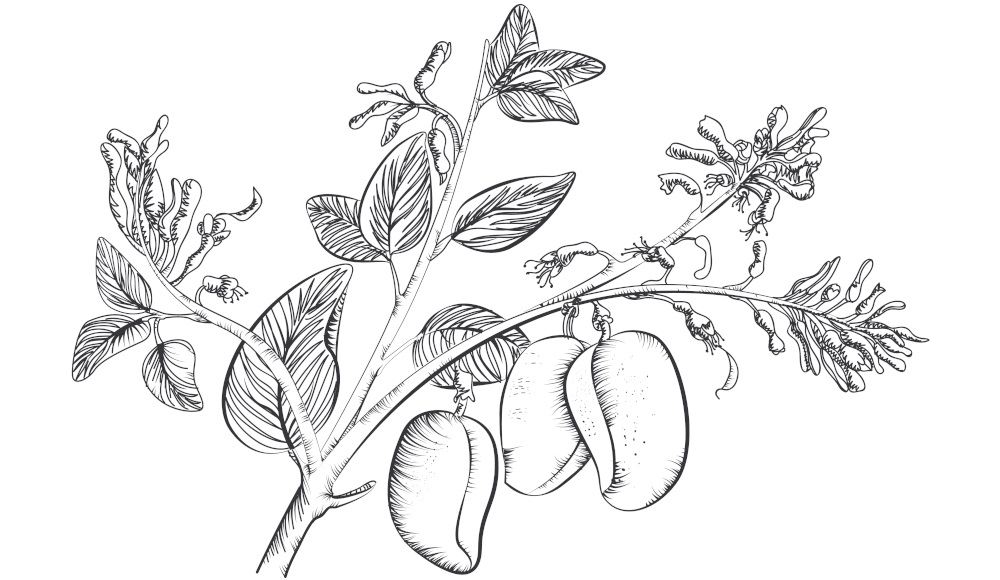
There grows Griffonia simplicifolia, a woody climbing shrub that has been highly valued for centuries in African herbal tradition. Its seeds are the richest known botanical source of pure 5-HTP1. Whilst humans have to manufacture 5-HTP with a lot of metabolic effort, this plant synthesises and stores it naturally in its pods, containing up to 20% of this compound in its dry weight.
Thanks to modern extraction technology, it is now possible to isolate this active compound. When looking for options to integrate this nutrient into your routine, the most sensible choice from a bioavailability standpoint is to opt for a high-purity Griffonia 5-HTP. These types of standardised extracts ensure that the body receives the exact molecule, ready to cross into the brain and support serotonin levels and, subsequently, the regulation of melatonin for optimal rest.
Side effects and contraindications
Griffonia simplicifolia and its 5-HTP extract are generally very well tolerated when the recommended doses are respected. Being a molecule that the body recognises as its own, adverse effects are rare and mild.
In some people, especially if taken on an empty stomach or in very high initial doses, it can cause transient gastrointestinal discomfort such as mild nausea, a heavy stomach, or heartburn. These discomforts usually disappear upon reducing the amount or taking the capsule alongside food. In very isolated cases, daytime drowsiness has been reported, so it is preferable to observe how the body reacts before carrying out activities that require maximum alertness.
Who should not take 5-HTP or Griffonia extracts?
Given that 5-HTP directly intervenes in serotonin synthesis, it should never be combined with antidepressant medication. Mixing them could cause an excess of serotonin in the brain (serotonin syndrome), which is dangerous.
Nor should it be consumed by pregnant or breastfeeding women, or individuals taking anxiolytic medication, sedatives, or Parkinson's treatments, without the express supervision of their doctor.
Bibliography
- 5-Hydroxytryptophan (5-HTP): Natural Occurrence, Analysis, Biosynthesis, Biotechnology, Physiology and Toxicology. Maffei, M. E. (2021). International Journal of Molecular Sciences, 22(1), 181.
- The Effects of 5-Hydroxytryptophan in Combination with Different Fatty Acids on Gastrointestinal Functions: A Pilot Experiment. Pilz, S. et al. (2014). International Journal of Molecular Sciences, 15(10), 18012-18024.
- Harnessing Plant-Derived Tryptophan: Bridging the Gap Between Neurobiology and Psychiatry in Depression Management. Frimpong, E. K. et al. (2026). Preprints ResearchGate.
About the author
Content researched and written by the Anastore editorial team.
Reviewed and verified against scientific literature by our Nutrition and Research Department.
Find out more about our editorial policy and scientific rigour.

This article is strictly for informational purposes and does not replace the advice of a healthcare professional.