
Is hyaluronic acid better in capsules or serum?
You wash your face in the morning, apply your usual moisturiser, and instantly your face feels soft and soothed. However, just a couple of hours later, especially if you are in an office with heating or air conditioning, that uncomfortable tight sensation returns. Why does this happen?
No matter how much cream we apply to the surface, the skin is a barrier designed precisely so that things do not enter easily. Its main job is to protect us from the outside.
This brings us to one of the most common questions when we look to improve bodily hydration: to maintain moisture and a healthy skin appearance, is it more effective to apply hyaluronic acid directly to the face or to take it as a supplement?
To resolve this daily dilemma and understand which option best suits what your body needs, let's look, in a very simple way, at how water travels through our skin and what role hyaluronic acid plays.
What our skin is made of
To understand why creams sometimes don't seem to be enough, it helps to imagine our skin as a two-storey house.
The top floor, the one we see and touch daily, is the epidermis. It acts as the roof of the house. Its mission is to act as a shield against the wind, cold, pollution, and to prevent the water we hold inside from evaporating quickly to the outside.
The ground floor, called the dermis, is the foundation and walls of the house. It is a much thicker layer where we find what we could call the "mattress" of the skin. This mattress is made up of fibres that give it firmness (such as collagen) and a gel-like substance that fills all the gaps, keeping the structure hydrated and flexible. The undisputed star of this natural gel is hyaluronic acid.
And what does hyaluronic acid do?
Hyaluronic acid is, basically, a type of sugar that our body manufactures itself. It has a quality that makes it unique: it works like a super-powerful sponge. It is capable of trapping and retaining a much greater amount of water than its own weight. In our body, this natural water reserve is directly related to skin volume and forms part of the fluid present in our joints.
What is the problem with the hyaluronic acid we produce?
Over the years, our body's natural "factories" become a bit more sluggish and produce less of this sugar. With fewer "sponges" in the skin's mattress, it retains less water, loses its volume, and we start to notice drier or less elastic skin.
To compensate for this drop in production, we have two paths: helping from the outside (the roof / serum) or helping from the inside (the foundations / capsules).
Hyaluronic acid serum: the protective shield against dryness
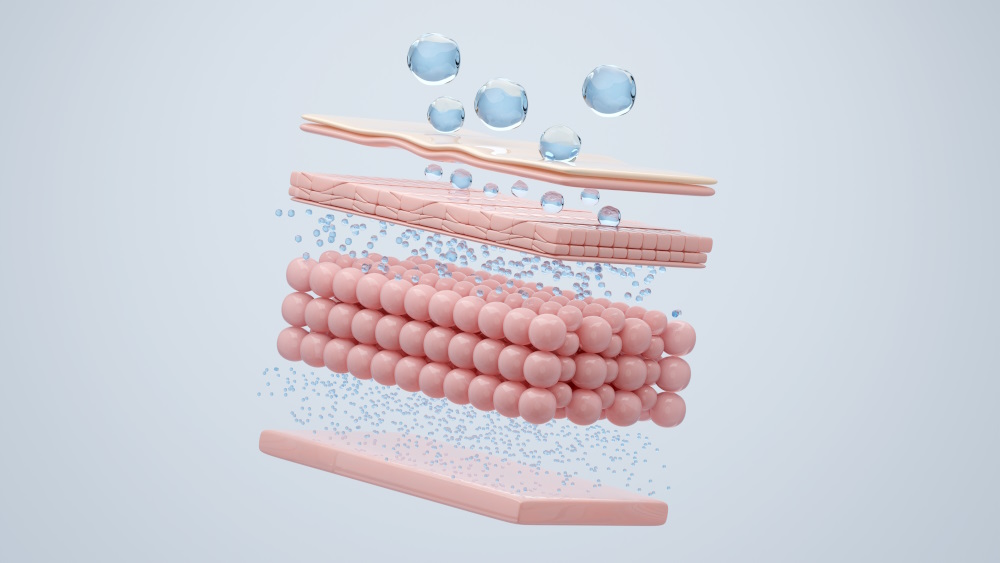
When we use cosmetics, we are working exclusively on the top floor, on the roof of our skin.
Throughout the day, our skin constantly loses water. Water evaporates to the outside, a process that worsens significantly in winter due to the contrast between the cold outdoors and indoor heating, or in summer due to the sun and air conditioning. All this environmental stress "steals" moisture from our face.
This is where topical use comes into play. By applying it to the skin, hyaluronic acid creates a sort of invisible, breathable layer or film that stops the water in our body from escaping. Furthermore, as it is a moisture-trapping molecule, it is capable of drawing water from the environment and keeping it on our skin.
What is molecular weight and why is it important?
It is interesting to know that in cosmetics there are different sizes of this molecule (which is also known as molecular weight):
-
Large molecules
They are like tennis balls trying to pass through a sieve. They cannot enter the skin, so they remain on the surface. Their job is to form a protective shield that provides immediate comfort and leaves the skin soft to the touch.
-
Small molecules
They are tinier and manage to slip a bit further down, but always within the superficial layers. They help retain water a little deeper, giving a feeling of greater hydration.
The daily use of a hyaluronic acid facial serum takes advantage of these properties. Being a water-based product, it is absorbed quickly and its ingredients settle on the outermost layer, helping to slow down daily water loss.
However, this hydration does not reach the "ground floor" or the bloodstream, where the true supporting mattress resides.
Hyaluronic acid capsules: hydration from the root
If the serum looks after the roof, taking hyaluronic acid as a supplement is the way to water the roots and nourish the foundations of the house.
For a long time, it was believed that taking hyaluronic acid orally was pointless because stomach juices degraded it, preventing its assimilation. However, current scientific evidence shows a different picture.
How hyaluronic acid gets from the stomach to the skin
When we ingest it, our digestive system does not destroy it, but rather "cuts" it into smaller, more manageable pieces. These tiny pieces pass through the intestines and reach the blood. Once in the bloodstream, the body is in charge of distributing them to where they are needed most.
Through the blood, these small fragments reach the dermis (the ground floor of the skin) and the fluid that bathes our joints. By incorporating into the tissue matrix, they provide structural components. In addition, recent research suggests that the presence of these fragments could interact with cells to support the natural synthesis of our own hyaluronic acid. In other words, it acts as a reminder for our internal "factories".
Biotechnology: The modern and clean alternative
A very important aspect when we talk about ingesting this ingredient is knowing where it comes from.
-
In the past, the only way to get it was by extracting it from animals, such as rooster combs, which was neither the cleanest option nor suitable for everyone.
Fortunately, nowadays there is no need to resort to that. Modern options use a biotechnologically produced hyaluronic acid. This means it is obtained through a natural fermentation process (similar to how yoghurt or sourdough is made, but at a laboratory level) using beneficial bacteria.
The result? A completely plant-based ingredient, suitable for vegans, environmentally friendly, and with a very high degree of purity. This ensures that what reaches your stomach is clean and the body recognises and assimilates it perfectly normally.
Why choose if you can have both? Serum and capsules
After seeing how each one works, the answer to the dilemma of whether the oral or topical route is better is simple: you don't have to choose. They are two forms of care that complement each other perfectly because they do completely different jobs. Skincare requires common sense; there is little use in having very strong foundations if the roof leaks, and vice versa.
To make it clearer, here is a summary of how hyaluronic acid serum and capsules complement each other:
| Feature | Serum (from the outside) | Capsules (from the inside) |
|---|---|---|
| Where does it work? | On the surface (the skin's outer barrier). | Deep down (inner layers and joints). |
| What exactly does it do? | It slows down water evaporation due to the weather and softens to the touch. | It provides raw material from the blood to the skin's internal mattress. |
| When is it noticed? | It provides a very quick feeling of relief and hydration. | It is background work; the results follow the body's natural cycle. |
| The main goal | To protect our "facade" against wind, cold, and air conditioning. | To maintain the body's overall structure and water reserves. |
If your skin is constantly exposed to strong heating, you notice superficial tightness, or you are simply looking for that fresh feeling in the mornings, using a serum is the logical step.
If, on the other hand, you feel you need overall support because external hydration is not enough, or you are looking for deeper, long-term maintenance that also takes other areas of the body into account, oral supplementation gives you that foundation from the inside.
Combining both methods is the most complete way to help your body manage its water reserves, protecting what you have inside and preventing outside aggressions from damaging it.
Precautions and side effects of hyaluronic acid
Hyaluronic acid stands out for being a very gentle substance for our body, as we produce it naturally ourselves. Its use is very safe, but it is always good to keep a few details in mind.
When applying it to the skin, problems are almost non-existent. Only in very rare cases, or if the serum has other added perfumes, might you notice slight, temporary redness.
When taking it in capsules, digestion is usually normal, although some people with a slightly more delicate stomach might notice a somewhat heavy digestion for the first few days.
Who shouldn't take it?
As a general precautionary rule, women who are pregnant or breastfeeding should avoid taking it in supplements, simply because there are not enough studies during these stages. Likewise, if you are undergoing specific medical treatment, it is always advisable to consult your doctor before starting to take it.
Bibliography
- Oral Hyaluronic Acid Supplement: Efficacy in Skin Hydration, Elasticity, and Wrinkle Depth Reduction. Amin, P., Sarabi, A., Choe, S., Scott, S., Suh, S., & Mesinkovska, N. A. (2025). Journal of Drugs in Dermatology, 24(9), 910-919.
- Multicenter evaluation of a topical hyaluronic acid serum. Robinson, D. M., Vega, J., Palm, M. D., Bell, M., Widgerow, A. D., & Giannini, A. (2022). Journal of Cosmetic Dermatology, 21(9), 3848-3858.
About the author
Content researched and written by the Anastore editorial team.
Reviewed and verified against scientific literature by our Nutrition and Research Department.
Find out more about our editorial policy and scientific rigour.

This article is strictly for informational purposes and does not replace the advice of a healthcare professional.