Do you have muscle or joint discomfort? Discover the benefits of white willow
The benefits of white willow (Salix alba L.) are not a novelty for mankind. The ancient Egyptians, back in 1500 BC, were already using extracts from its leaves to soothe the joints1.
The Greeks echoed its virtues some 1,000 years later. Hippocrates of Kos, considered the father of medicine, used willow bark in cases of inflammation1 mainly in cases of muscle and joint inflammation.
Since then, its use spread across the globe: the rest of Europe, China, North America, South America, the Caribbean2... Everyone wanted to use this new rock star to strengthen and restore the body1.
With so much history, the question is: is it really that effective? Or is it the typical plant based on tradition rather than scientific evidence?
What are the benefits of white willow?
Beyond its historical use, there are 2 specific benefits that are repeated in the scientific literature.
It contributes to muscle and joint health5
For centuries, white willow has been used for joint health4.
Why?
Some of its components, due to their chemical structure, have analgesic and anti-inflammatory activity by intervening in the reduction of pro-inflammatory molecules (TNF-α, COX-2, and NF-κB)4.
In one piece of research, the effect of an oral dose of white willow bark extract was compared to a placebo in people with lower back discomfort6.
After 4 weeks, it was found that 39% of those who had received a high dose (240mg) felt better without the need for anti-inflammatories, such as some medical anti-inflammatories like tramadol. The percentage was 21% for those taking a low dose (120mg) and 6% in the placebo group6. It was therefore concluded that it could help soothe lower back pain6.
Likewise, its efficacy has been analysed in people with joint problems, where it has been observed that it contributes to the health of joints and muscles7.
It is a body strengthener and restorative8
One could say that white willow facilitates physical performance, due to its strengthening and restorative properties for the body8.
After all, exercise wears down muscles and joints, making it possible for discomfort to arise that limits training (oh, muscle stiffness, how little we like it).
Therefore, the contribution to muscle and joint health mentioned earlier could lead to greater mobility and an increase in the quality of training sessions4.
Is white willow good for the skin?
One of the most echoed benefits on the internet about this tree is that it improves skin appearance: it exfoliates, regenerates, prevents infections...
However, specific food supplements are recommended such as hyaluronic acid, vitamin A or vitamin C.
How to take white willow?
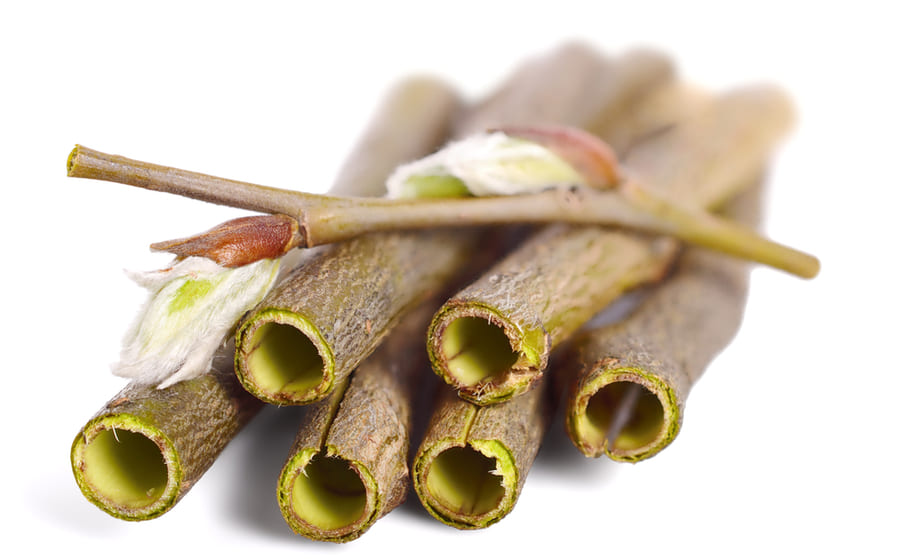
The bark is the part that concentrates the most salicin4, so it is the one usually used to prepare infusions, teas, or tisanes.
You can, for example, boil about 25g in a litre of water for 10 minutes, let it steep, add a few drops of sweetener (if you need it) and it's ready.
However, if what you want is to make the most of the benefits of white willow, choose a quality food supplement. There are different formats: powders, tablets, etc.
At Anastore, you have a 100% plant-based formula with dry bark extract titrated in salicin. They are capsules, each with 40 mg of salicin, manufactured under a method that ensures the highest effectiveness.
It is ideal for contributing to muscle and joint health5 in the face of ageing and damage derived from physical exercise.
Does white willow have contraindications?
In reality, it is quite safe and hardly any side effects have been reported beyond headaches, gastrointestinal discomfort, itching, and skin rashes9.
However, remember that the salicin contained in white willow is very similar to acetylsalicylic acid4.
You should be cautious:
- Do not even think about taking it if you are allergic to aspirin or other salicylates4.
- Avoid it if you suffer from gastritis, stomach ulcers, diabetes, asthma, gout, kidney disease, or bleeding disorders4, 9.
- Do not use it if you are being treated with anticoagulants, antiplatelets, beta-blockers (atenolol, propranolol...), diuretics, or NSAIDs. There may be a harmful interaction between them4. Also with herbs that have salicylates (meadowsweet, poplar bark...)9.
- If you are going to undergo surgery, stop taking it at least 2 weeks beforehand to avoid bleeding problems9.
- Nor is it recommended for pregnant women, and it is directly contraindicated during breastfeeding. The components of the bark extract can pass into breast milk and cause harm to the nursing baby9.

In any case, if you would like to benefit from white willow, it is always preferable to consult with your doctor to resolve any doubts. Like everything in life: common sense!
More information: what is white willow?
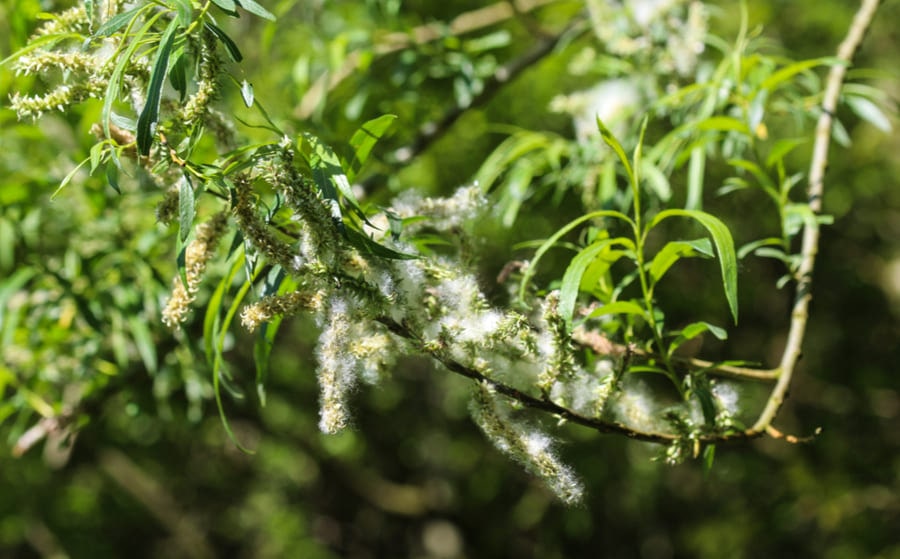
The white willow, also known as the European willow, is a large tree up to 25 metres tall with wide-spreading branches. Its trunk is straight, with a greyish, cracked bark2.
The leaves are elongated, alternate, narrow, and finely toothed. They are very characteristic, as they reflect light and appear to shine2.
The flowers are racemose (catkins), and bloom in spring. The fruits form capsules that upon ripening open to release seeds wrapped in a cottony tissue that facilitates dispersion through the air3.
It grows spontaneously in Europe, Asia, and North Africa, near humid places such as rivers and streams. In the Iberian Peninsula and the Balearic Islands, it is very common3.
Its exact natural habitat is not known, because since antiquity it has been planted in different places3.
A multipurpose tree
Its wood has been widely used at an industrial level for being light and flexible. For example, to manufacture matches, footwear, orthopaedic parts, toothpicks, etc.3.
However, if it stands out for anything, it is for its salicin content. A compound obtained mainly from the bark and responsible for most of the benefits of white willow3.
Perhaps it doesn't ring a bell. But...
What if I tell you that in the body it is transformed into salicylic acid, the molecule used to synthesise the acetylsalicylic acid in the widely known aspirin?4
No. Do not think that salicin is the natural version of this drug.
Although they are similar, their effectiveness and tolerance are not the same1.
Furthermore, in the bark extract there are other similar components (salicortin, saligenin...) that intervene, to a lesser extent, in the overall effect. Also polyphenols and flavonoids that have antioxidant properties4.
Bibliography
- Montinari MR, Minelli S, De Caterina R. The first 3500 years of aspirin history from its roots - A concise summary. Vascul Pharmacol. 2019; 113: 1-8. doi: 10.1016/j.vph.2018.10.008.
- Weber R. On the Cover. White willow. Ann Allergy Asthma Immunol. 2004; 92(2): A6. doi: 10.1016/s1081-1206(10)61545-1.
- Arbolapp [Internet]. Salix alba. [cited 26 Jul 2021].
- Shara M, Stohs S. Efficacy and Safety of White Willow Bark (Salix alba) Extracts. Phytother Res. 20156; 29(8): 1112-6. doi: 10.1002/ptr.5377.
- Extracted from the European Commission compilation list, under EFSA evaluation (ID 3884).
- Chrubasik S, Eisenberg E, Balan E, Weinberger T, Luzzati R, Conradt C. Treatment of low back pain exacerbations with willow bark extract: a randomized double-blind study. Am J Med. 2000; 109(1): 9-14. doi: 10.1016/s0002-9343(00)00442-3.
- Schmid B, Lüdtke R, Selbmann HK, Kötter I, Tschirdewahn B, Schaffner W, Heide L. Efficacy and tolerability of a standardized willow bark extract in patients with osteoarthritis: randomized placebo-controlled, double blind clinical trial. Phytother Res. 2001; 15(4): 344-50. doi: 10.1002/ptr.981.
- Extracted from the European Commission compilation list, under EFSA evaluation (ID 2488).
- MedlinePlus [Internet]. Willow bark. 2021 [cited 26 Jul 2021].
About the author
Content researched and written by the Anastore editorial team.
Reviewed and verified against scientific literature by our Nutrition and Research Department.
Find out more about our editorial policy and scientific rigour.

This article is strictly for informational purposes and does not replace the advice of a healthcare professional.