
Cordyceps: from the mysticism of Tibet to the science of modern supplementation
If you have heard of Cordyceps recently, it is highly likely that it was through popular culture, science fiction television series or nature documentaries. On screen, this fungus often stars in dystopian science fiction stories or astonishing jungle scenes. However, beyond the media sensationalism and its peculiar way of life in nature, the true Cordyceps sinensis holds one of the most fascinating stories in botany, the history of nutrition and food technology.
Today we are not going to talk about science fiction, but rather delve into the biological reality of this fungus, break down what its molecular structure hides and, most importantly, explain how science and food technology have made it possible for us to enjoy its active compounds in a safe, sustainable and standardised way in our day-to-day lives.
The "Himalayan Gold": a discovery at over 4,000 metres of altitude
To understand the prestige of Cordyceps sinensis, we must travel back in time and space to the frigid and inhospitable plains of Tibet, at altitudes exceeding 4,000 metres. In this extreme environment, where oxygen is scarce and temperatures are relentless, survival is a constant challenge.
The tradition
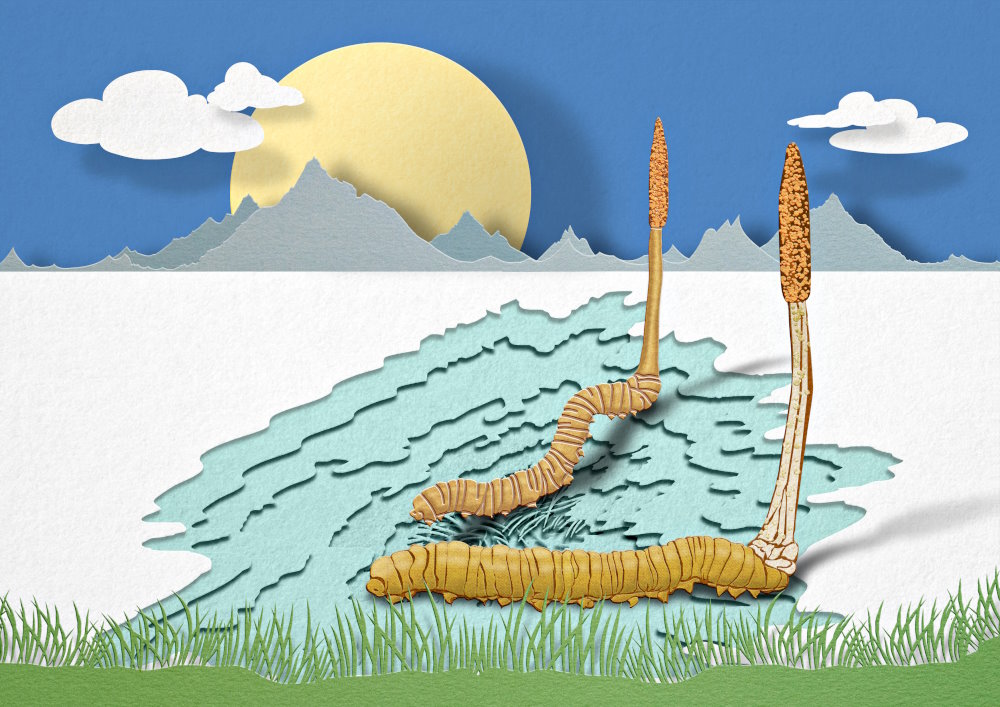
Tradition has it that over a thousand years ago, nomadic Tibetan herders noticed unusual behaviour in their flocks of yaks (the large bovids adapted to the high mountains). Following the spring thaw, the animals grazed in certain areas and, upon consuming a small club-shaped structure sprouting from the ground, they seemed to show extraordinary vitality and stamina. Intrigued by this phenomenon, the herders began to collect and consume this mysterious shoot, quickly integrating it into the local traditional culture.
The fungus soon caught the attention of the imperial dynasties. During the Qing dynasty in China, Cordyceps was considered such an exclusive and rare ingredient that its use was strictly reserved for the emperor's family and the high nobility. It was granted the status of a "superior tonic" in classical herbalist compendiums, a term used to classify those ingredients that were consumed daily not to treat acute ailments, but to accompany the human body in the search for continuous balance and well-being¹ ².
But what exactly was that small structure sprouting from the frozen earth?
What the biology of the wild fungus is like
The original scientific name of the wild fungus is Ophiocordyceps sinensis. Its life cycle is one of the most complex and studied phenomena of parasitism in mycology.
Unlike traditional button mushrooms or toadstools that grow on decaying wood or soil rich in organic matter, the wild Cordyceps sinensis is an entomopathogenic fungus. This means that it needs an insect host to develop. In the Tibetan meadows, the spores of the fungus infect the subterranean larvae of specific moths of the Thitarodes genus (known as ghost moths).
During the winter, the mycelium (the "root" of the fungus) slowly colonises the inside of the larva underground. When spring arrives, the fungus uses the nutrients of the larva to produce a fruiting body (the mushroom itself), which breaks through the soil and surfaces in search of light to release new spores³. It is this curious duality that gave it its traditional Chinese name, Dong Chong Xia Cao, which poetically translates to "winter worm, summer grass".
Although this biological cycle is a marvel of nature, it poses a great problem for its consumption in the modern world.
What is inside? The biochemistry of cordyceps
The respect that ancient traditions held for this fungus was no coincidence. When modern analytical chemistry began to study Cordyceps sinensis in the 20th century, it discovered a highly complex nutritional and phytochemical profile.
Cordyceps is not a simple nutrient; it is a matrix of bioactive compounds that interact synergistically. Among the most prominent, which are the continuous subject of in vitro studies and biochemical research, we find:
1. Polysaccharides (Beta-glucans)
Polysaccharides are complex carbohydrates made up of long chains of simple sugars. In the Fungi kingdom, and especially in Cordyceps, beta-glucans stand out. These molecules form part of the cell wall of the fungus. In contemporary nutritional research, fungal beta-glucans are highly valued and studied for their cellular interaction in the human digestive tract⁴. They are large, complex molecules that our body recognises, and their high concentration is one of the main quality markers of a good fungus.
2. Cordycepic Acid (D-Mannitol)
This compound, named after the fungus itself, is biochemically identical to D-mannitol, a polyol or sugar alcohol. In nature, cordycepic acid acts as an osmoregulator, helping the fungus to survive the extreme cold and osmotic stress of the Himalayan peaks. In human nutrition, cordycepic acid is the second major standardisation marker.
3. Adenosine and other nucleosides
Adenosine is a nucleic acid present in all living cells and is a fundamental piece of ATP (Adenosine Triphosphate), the "energy currency" of our cells. Cordyceps is naturally rich in nucleosides such as adenosine, uridine and guanosine. These compounds are the subject of intense fascination in the field of sports nutrition and active performance, as they are fundamental metabolites in the biochemical processes of cellular energy transfer⁵.
4. Ergosterol
Ergosterol is a component of fungal cell membranes and fulfills a function similar to cholesterol in animals. It is biologically important because it is a natural precursor to vitamin D2, an essential vitamin for the normal physiological maintenance of the organism.
Why you should NOT look for wild Cordyceps sinensis
At this point, logic would tell us that to take advantage of these compounds we should consume the wild fungus directly from Tibet. However, this is nowadays unsustainable, unaffordable and, from a food safety point of view, ill-advised.
Global demand for the "winter worm" fungus grew so much in recent decades that it led to uncontrolled harvesting. This has resulted in the ecological degradation of the Tibetan meadows.
-
Due to its extreme scarcity, the price of wild Ophiocordyceps sinensis has come to exceed 20,000 euros per kilogram in Asian markets, earning it the nickname "soft gold".
But the problem is not just ethical or economic. The greatest risk of the wild fungus is contamination. Fungi are exceptional bioaccumulators; they act like sponges that absorb everything in the soil. Wild Cordyceps often features high levels of heavy metals (such as lead and arsenic) naturally present in the soils of certain regions of Asia. Consuming the wild fungus today is, quite simply, a toxicological risk.
The technological revolution: fermentation and the CS-4 strain
Faced with the risk of extinction of the wild fungus and the need to offer a safe ingredient, free of heavy metals and at an accessible price, biotechnology made its appearance in the 1980s.
Chinese scientists managed to isolate pure strains of Cordyceps sinensis mycelium from wild specimens. After years of trials, they discovered that one particular strain, the CS-4 strain (Paecilomyces hepiali), cultivated through a liquid fermentation process, produced a profile of active compounds (polysaccharides, cordycepic acid, adenosine) practically identical to that of the wild fungus⁶.
This technological breakthrough revolutionised the world of supplementation. Cultivation by liquid fermentation in controlled stainless steel bioreactors allows for:
- Safety: It is cultivated in an aseptic environment, free from contamination by heavy metals, pesticides or insects.
- Sustainability: The ecosystem of Tibet is protected, leaving the wild fungus in peace.
- Consistency: Controlled conditions (temperature, pH, nutrients) allow each batch to have exactly the same amount of active principles, something impossible in nature.
- Suitable for vegans and vegetarians: As it is cultivated in a plant-based liquid medium and does not use moth larvae, the CS-4 strain extract is 100% suitable for vegans and vegetarians.
Bioavailability and standardisation as marks of quality
If you have decided to incorporate this fascinating fungus into your daily routine to accompany your active lifestyle, you will face a market full of options. However, you should know that not all cordyceps products are equal.
There are two food technology concepts that you must always demand when reading a label: Extraction and Standardisation (Titration).
The problem with raw powder
-
Many cheap products simply grind the dried fungus and encapsulate it (raw powder).
This is a nutritional mistake. The cell walls of fungi are composed of chitin, the same resilient substance that forms the shell of crabs. The human stomach lacks the enzyme chitinase in sufficient quantities to break it down. If you consume raw fungus powder, the majority of its valuable polysaccharides and active compounds will pass through your digestive system without being absorbed.
The solution: the standardised extract
To release the active principles and make them bioavailable (easy for your body to absorb), the fungus must undergo an extraction process (usually with hot water). This process breaks down the chitin and concentrates the bioactive molecules.
-
Once extracted, the manufacturer measures the concentration of these compounds to guarantee their actual presence. This is what is known as a standardised or titrated extract.
It is precisely here where Anastore's Cordyceps Sinensis stands out. This product is not just ground powder, but a highly purified extract from the highest quality pure CS-4 strain mycelium, obtained through a patented fermentation process (CordycepsPrime™). What makes it a technologically superior product is its standardisation: it is titrated to 8% in cordycepic acid and 0.28% in adenosine.
This transparent formulation ensures that in each capsule you are getting exactly the density of phytochemicals for which the fungus is globally valued, presented in vegetable capsules and produced under strict European food safety regulations.
The end of the journey
The journey of Cordyceps sinensis from the freezing plains of the Himalayas to modern biotechnology laboratories is a testament to how science can ally itself with ancient traditions. Today we do not need to put the Tibetan ecosystem at risk, nor pay exorbitant sums, nor consume products of doubtful safety to access the biochemical complexity of this fungus.
Thanks to the isolation of the CS-4 strain and standardised extraction processes, we have food supplements of great purity and integrity at our disposal.
-
If you are looking for a natural ally to complement a demanding, active lifestyle focused on comprehensive well-being, opting for a transparent and titrated extract is the only scientifically logical decision.
Bibliography
- Halpern, G. M. (1999). Cordyceps: China's healing mushroom. Avery Publishing Group.
- Panda, A. K., & Swain, K. C. (2011). Traditional uses and medicinal potential of Cordyceps sinensis of Sikkim. Journal of Ayurveda and integrative medicine, 2(1), 9–13.
- Shrestha, B., Zhang, W., Zhang, Y., & Liu, X. (2010). What is the Chinese caterpillar fungus Ophiocordyceps sinensis (Ophiocordycipitaceae)?. Mycology, 1(4), 228-236.
- Wasser, S. P. (2002). Medicinal mushrooms as a source of antitumor and immunomodulating polysaccharides. Applied microbiology and biotechnology, 60(3), 258-274.
- Zhu, J. S., Halpern, G. M., & Jones, K. (1998). The scientific rediscovery of an ancient Chinese herbal medicine: Cordyceps sinensis: part I. The Journal of Alternative and Complementary Medicine, 4(3), 289-303.
- Holliday, J., & Cleaver, M. (2008). Medicinal value of the caterpillar fungi species of the genus Cordyceps (Fr.) Link (Ascomycetes). A review. International journal of medicinal mushrooms, 10(3).
About the author
Content researched and written by the Anastore editorial team.
Reviewed and verified against scientific literature by our Nutrition and Research Department.
Find out more about our editorial policy and scientific rigour.

This article is strictly for informational purposes and does not replace the advice of a healthcare professional.